If you have ever looked inside your fuse box and wondered what all those little switches actually do, you are not alone. Most homeowners in Beaconsfield and the surrounding villages have a rough idea that the board protects them from electric shock and fire, but the difference between an RCD, an RCBO and an SPD can feel like alphabet soup. This guide walks through each device in plain terms, the way you might explain it to a neighbour over the fence, and then explains why it matters when your board needs replacing or upgrading.
What does an RCD actually do?
RCD stands for residual current device. Picture the electricity flowing out from your board along the live wire to a socket or light, and then returning along the neutral wire. Under normal conditions those two currents are equal. The moment they differ, even by a tiny amount, it means current is leaking somewhere it should not be, most likely through a person or through a fault to earth. The RCD detects that imbalance and cuts the power in a fraction of a second, fast enough to prevent a fatal shock in most situations.
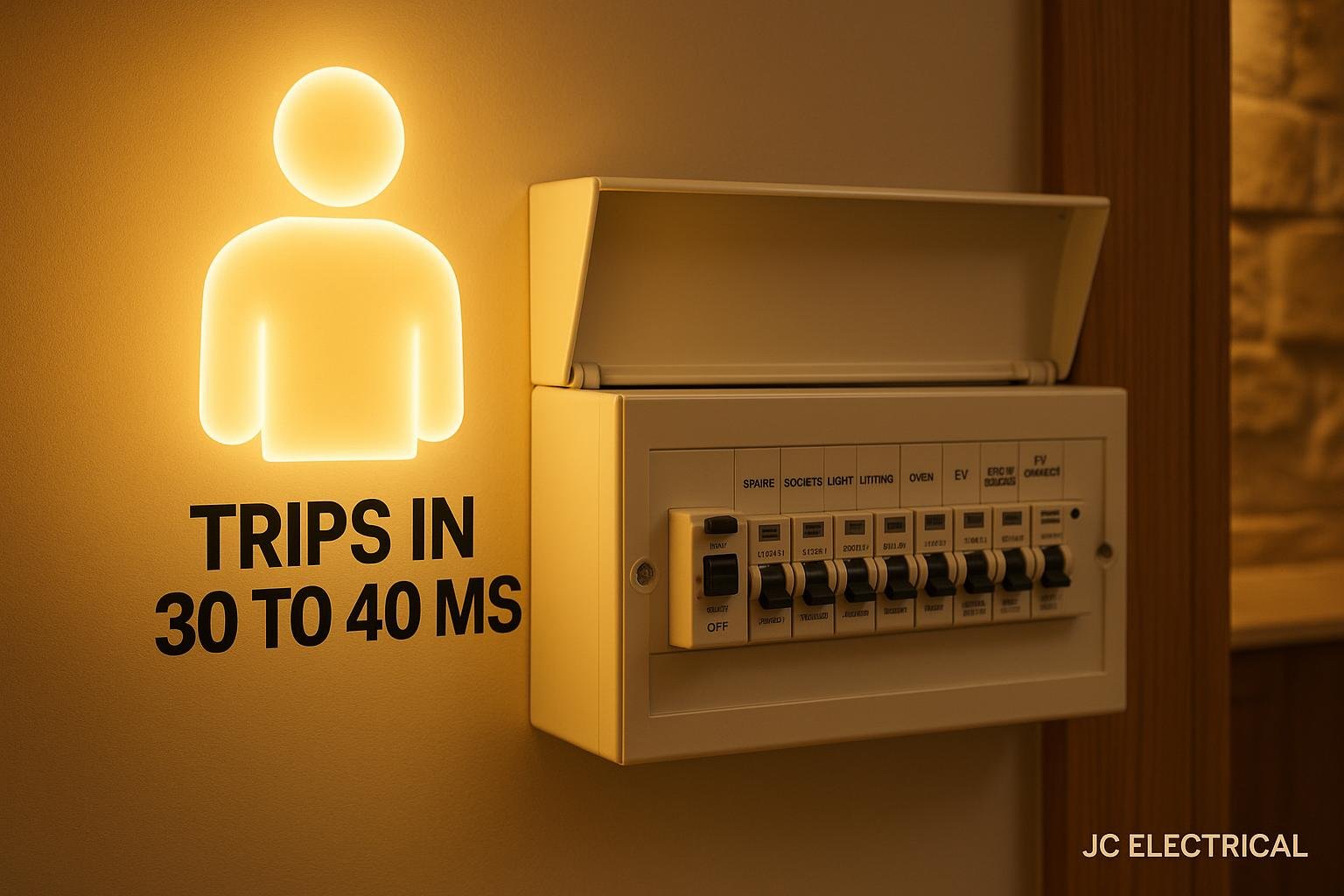
To put a number on how fast that is: a well-functioning RCD trips in around 30 to 40 milliseconds when it detects a leakage current at its rated threshold. The human heart can be thrown into a dangerous rhythm by contact lasting less than a second, so that speed of response is what makes the device genuinely life-saving rather than merely useful. It is worth understanding this because some homeowners assume the RCD is there to protect their appliances. It is primarily there to protect people, and the threshold it trips at is deliberately set to be lower than the level that would cause lasting harm.
Older consumer units often have one or two RCDs covering all the circuits between them. That arrangement works, but it has a well-known weakness: if one circuit develops a fault, the RCD trips and takes down every circuit it protects. Lights, sockets, the fridge, the freezer, all off at once. That is frustrating at the best of times and a genuine problem in winter or when someone has medical equipment at home. A common scenario is a faulty washing machine with a failing heating element that allows a tiny current to leak to earth. Unplug the machine and the RCD stops tripping. Leave it plugged in and the nuisance trips continue, and every time they do, everything on that half of the board loses power.
What is an RCBO and why do modern boards use one per circuit?
An RCBO combines two protective functions in a single unit. It does the residual-current protection of an RCD and it also acts as a miniature circuit breaker, protecting against overloads and short circuits. The key difference is that each RCBO looks after exactly one circuit. When a fault occurs on the kitchen ring, only the kitchen ring drops out. Everything else stays live.
This is why board upgrades in Beaconsfield increasingly involve fitting individual RCBOs rather than the older arrangement of shared RCDs with plain circuit breakers. The board costs a little more in parts, but the convenience and the clarity of fault-finding are worth it. When only one breaker trips, you know immediately which circuit has the problem, and isolating the cause takes minutes rather than a process of elimination in the dark.
To see why this matters in practice, consider a house with a dedicated circuit for an upstairs home office and a separate circuit for the downstairs sockets. On an older board with a shared RCD, a fault in the office could black out the downstairs sockets too, perhaps killing a chest freezer for hours before anyone notices. On an RCBO board, the office circuit drops, the freezer stays running, and the homeowner knows exactly where to look. That kind of precision also helps an electrician diagnose the fault quickly, which in turn keeps any call-out time shorter.
For families with a home office, a chest freezer full of food, or anyone on a CPAP machine or similar device, the single-circuit protection of an RCBO is not just a convenience, it is a practical safety improvement.
What is a surge protection device and when is it worth fitting?
An SPD, or surge protection device, is a component that sits inside or very close to your consumer unit and clamps sudden voltage spikes before they can travel through your wiring and reach your appliances. Those spikes happen more often than people realise. Lightning striking nearby, the national grid switching large loads, even a neighbours heavy motor starting up can send a brief spike down the supply. For a kettle or a lamp, a spike is rarely a problem. For a smart TV, a laptop, a heat pump controller or an EV charger, even a short-lived overvoltage can shorten the component life or cause an immediate failure.
A common misunderstanding is that a power strip with a built-in surge absorber gives the same protection as a properly rated SPD at the board. Those strips contain a component that degrades with each surge it absorbs, and they give no indication when they have reached the end of their useful life. A board-level SPD is rated to handle a far greater energy level and, in most cases, will signal when it needs replacing. Relying on a plug-in strip for an EV charger or a heat pump controller, both of which are permanently wired rather than plugged in, is not an option at all.
Not every home needs one, and a small terraced house with modest electronics probably gets by without. But if you live in a larger property in Penn, Knotty Green or Gerrards Cross and you have invested in a home office setup, a network of smart home devices, an EV charger or a heat pump, the cost of adding an SPD at the same time as a board upgrade is modest relative to the replacement value of what it protects. Fitting it later costs more because there is additional labour involved in opening the board again.
The SPD does nothing visible day to day. You will never notice it working. That is rather the point.
How do these devices relate to each other inside the board?
Think of them as three layers of protection doing different jobs. The main switch at the top of the board isolates everything. The RCBOs, one per circuit, provide both overload protection and shock protection for each individual circuit. The SPD, if fitted, guards against transient voltage spikes arriving from the supply. They work together rather than duplicating each other.
A well-specified modern board has all three elements. A board from fifteen or twenty years ago might have two shared RCDs and a row of plain MCBs, which gives good protection but lacks the per-circuit granularity of RCBOs and has no spike protection at all. That older arrangement is not necessarily dangerous if the wiring is in good condition, but it does not meet what would be fitted today, and if the board itself is the original from the 1990s it may also be approaching the end of its reliable service life.
One question homeowners sometimes raise is whether the consumer unit enclosure needs to change as well as the devices inside it. The answer depends on the material. Older boards often have a wooden or plastic enclosure that does not meet the current requirement for a non-combustible enclosure. Replacing the devices while leaving an unsuitable enclosure in place is not best practice, and a competent electrician will replace the whole assembly rather than just swapping components into an old shell.
Does my board need replacing or just checking?
The devices themselves rarely fail without warning. What changes over time is the wiring they protect, and the demands placed on the system as kitchens gain more appliances, garages gain EV chargers, and home offices draw continuous loads. Signs that the board deserves a proper look include circuits that trip more frequently than they used to, a board that still uses the older wire-fuse system rather than circuit breakers, or an EICR report that has come back with observations about the protective devices.
Another thing worth checking is whether your current board has enough spare ways to accommodate new circuits. A house that started with eight circuits and has since gained an electric shower, a garden socket, and a garage supply may already be at capacity, with additional circuits doubled up in ways that were never intended. A board with no room to grow cleanly is often a reason to upgrade proactively, before a new installation forces the issue at short notice.
If you are unsure whether your board is up to what your household asks of it, an EICR is the sensible first step. It gives a clear picture of the wiring and the board without committing to any particular work. In Beaconsfield and the surrounding area, that inspection typically takes half a day for a standard house and leaves you with a written record of what is in good order and what needs attention.
What happens during a consumer unit upgrade?
The electrician isolates the supply at the meter tails, removes the old board, and installs the new consumer unit in its place. Each circuit is connected to its own RCBO. If an SPD is being added, it goes in at the same time. The whole installation is then tested circuit by circuit before the supply is restored. You receive an Electrical Installation Certificate once testing confirms everything is within the required limits.
Power is off for most of the working day, so it is worth putting perishables in a cool bag and planning a day out if young children are involved. On a house with up to ten circuits in good condition the work is usually done and tested within one day. Larger homes with more circuits, or where some wiring needs attention before the new board can be connected cleanly, may run into a second day.
It is also worth asking your electrician in advance what access they will need. The board is usually in a cupboard under the stairs or in a utility room, and that space sometimes holds a lot of stored items. Clearing it before the day saves time and means the electrician can get straight to work rather than moving boxes first.
Is this work I need to notify the council about?
Consumer unit replacement falls under Part P of the Building Regulations in England. A registered electrician handles the notification process automatically, registering the work with the relevant body and ensuring you receive the appropriate certificate. You do not need to do anything separately. The certificate becomes part of your property’s compliance history, and it is the document that conveys and mortgage solicitors will look for when the house is eventually sold. Keep it with your title deeds rather than in a kitchen drawer.
If you are in Amersham, Marlow, Wooburn Green, Burnham or anywhere else across South Buckinghamshire, the same notification process applies regardless of which district the property sits in.
Ready to talk about your board?
If anything in this guide has raised a question about your own consumer unit, the best next step is a quick conversation about what you have got and what your household actually needs. Use the contact form or phone number on this page to send the details of your property, and Jess will come back to you with a straightforward assessment of what would make sense.