
Your electric shower trips the RCD and suddenly half the house goes dark. It is one of the more unsettling things that can happen on a weekday evening, especially if you have children to get ready for school in the morning. The good news is that the RCD is doing exactly what it is supposed to do: it has detected a fault and cut the power before anything worse happened. The less welcome news is that you cannot simply keep resetting it and carrying on. There is a real fault somewhere, and it needs finding.
What should I do right now, tonight?
Turn the shower off at the pull cord or isolator switch, then go to your consumer unit and reset the RCD. If the rest of the house holds and only the shower circuit stays off, you have confirmed that the fault is in the shower or its dedicated wiring, not somewhere else in the house. That is useful information, and it is safe to leave things that way overnight. Use a different bathroom, or boil a kettle and make do.
If the RCD trips again even with the shower isolator off, do not keep resetting it. That means the fault is either in the shower circuit wiring between the board and the shower, or something else on the same RCD is also leaking to earth. At that point, stop resetting and call an electrician in the morning. The same applies if the RCD will not reset at all: leave it off and call.
Do not remove the shower cover or poke around inside the unit yourself. Electric showers run at mains voltage and store charge in components even after you switch them off. This is one job where looking inside makes things worse, not better.
Why does an electric shower trip the RCD?
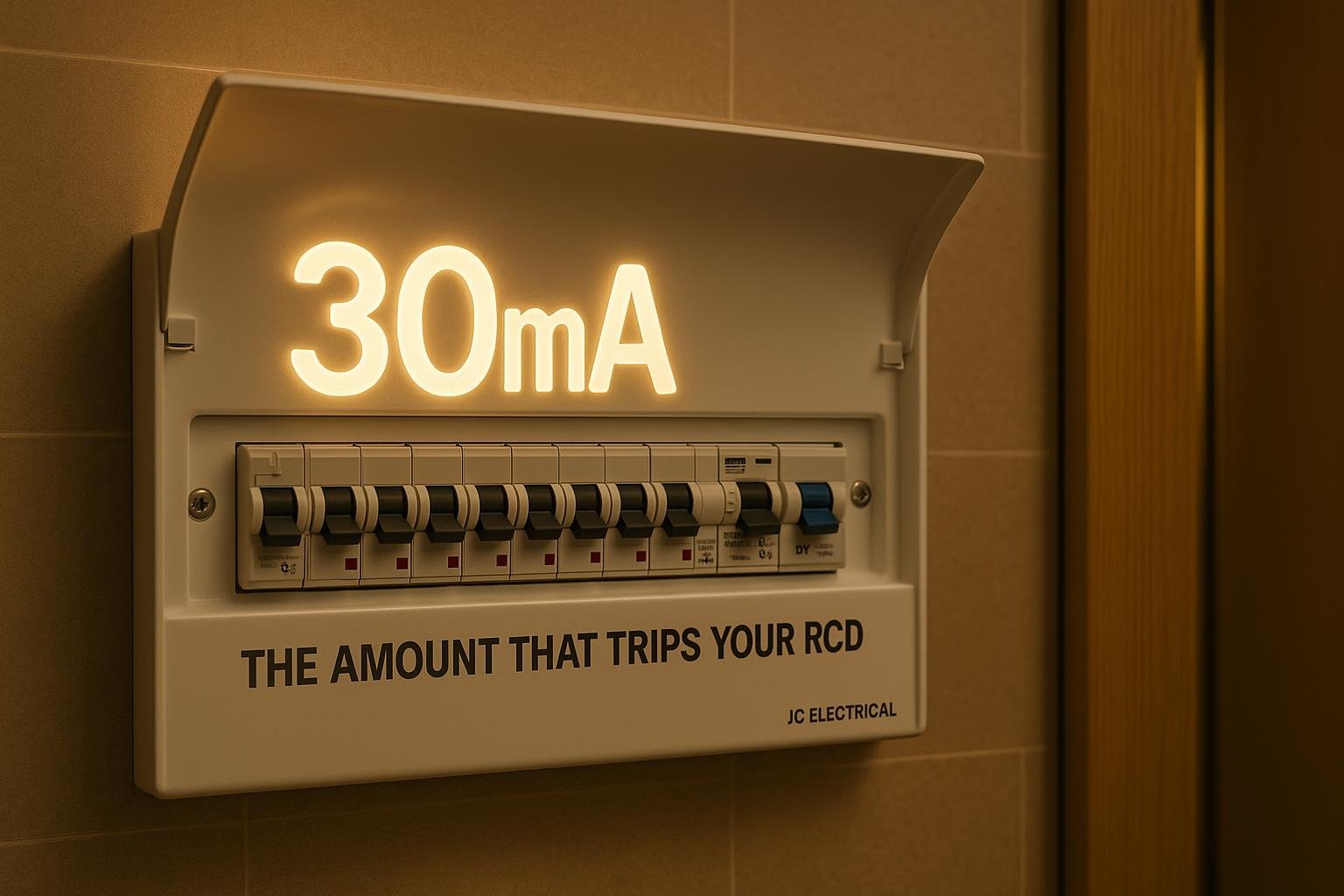
The most common cause is a degraded heating element. The element inside a shower unit is a coil of resistance wire surrounded by insulating material, and that insulation breaks down over time, especially if the shower runs hard water. Once the insulation cracks, a small amount of current leaks to earth. The RCD is set to trip at 30 milliamps, which is a tiny amount, so even a small leak is enough to trip it. The shower may still produce hot water right up until the moment it trips, which is why people are sometimes surprised that anything is wrong.
The second cause is moisture inside the shower unit or the cable connections. Shower rooms in older houses in Penn, Knotty Green and similar villages often have less ventilation than modern bathrooms, and condensation finds its way into places it should not. A damp connection can leak to earth in exactly the same way as a failing element.
The third cause is wiring that has aged or been damaged. If the shower cable runs through a loft, under floorboards or behind tiles and has been there for many years, the insulation may have hardened and cracked. Rodent damage is more common than most people expect, particularly in older detached properties.
Finally, the fault might not be in the shower at all. If your shower shares an RCD with other circuits, something else on that same RCD could be the culprit. Resetting with the shower isolator off will tell you whether that is the case.
How does the electrician find out which it is?
The first thing a competent electrician does is an insulation resistance test on the shower circuit. This measures how well the insulation is holding up between the live conductors and earth. A healthy circuit gives a very high reading. A failing element or damaged cable gives a low one, and the test usually points clearly at which part of the circuit is at fault.
If the element is the problem, it can often be replaced without changing the whole shower unit, provided the unit is not too old and the replacement part is still available. If the wiring is the problem, the electrician will trace the cable and identify where the damage is. If the fault is intermittent and hard to pin down, a more thorough inspection of the board and all the circuits on that RCD may be needed.
What usually fixes it?
In the majority of cases it is one of two things. Either the heating element is replaced, which is a straightforward repair, or an RCBO is fitted to the shower circuit at the consumer unit.
An RCBO does the job of both a circuit breaker and an RCD in a single device. Fitting one to the shower circuit means that if the shower develops a fault in future, only the shower circuit trips. The rest of the house stays on. This is a much more sensible arrangement than having the shower share an RCD with the kitchen or the landing lights, and many electricians will recommend it as part of the same visit even if the immediate fault turns out to be the element.
In some older properties, the consumer unit itself is the limiting factor. If the board is a very old fuse board or a type that cannot accept modern RCBO devices, a board upgrade may be the right long-term answer. You can read more about what that involves on the full board upgrades page for Beaconsfield. The range at the top of this page covers the typical cost of that work.
Does this mean my shower needs replacing entirely?
Not necessarily. If the element is the only fault and the unit is not too old, a repair is often the more economical choice. If the unit is more than ten or twelve years old, the element has already failed once, and the shower is showing other signs of wear, a new shower unit fitted at the same time as the wiring work can make sense. The electrician can give you an honest view once the fault is diagnosed. There is no reason to replace a shower that still has useful life in it just because an element has worn out.
Could this be a sign of a wider wiring problem?
Sometimes, yes. A shower that trips the RCD is usually a localised fault, but if your home is older and the wiring has not been looked at in many years, it is worth having a broader conversation while the electrician is there. If you have noticed other things, flickering lights, sockets that feel warm, breakers that trip for no obvious reason, those are worth mentioning. An electrician doing a shower repair can often spot signs of wider issues during the same visit without it turning into a major investigation.
Properties in Gerrards Cross, Amersham and the surrounding villages often have wiring that dates back several decades. That does not automatically mean it is unsafe, but it does mean it benefits from a periodic check. An electrical installation condition report gives you a clear picture of what is fine and what needs attention, without committing you to any remedial work upfront.
What if I am renting the property?
If you are a tenant, report the fault to your landlord in writing as soon as possible and keep a copy. Do not use the shower until it has been inspected. The landlord has a legal duty to keep the electrical installation in a safe condition, and a shower that repeatedly trips the RCD is not in a safe condition. If the landlord is slow to act, the local council’s housing team has powers to require action.
If you are a landlord, a shower fault that trips the RCD is not something to leave for the next routine inspection. Get it looked at promptly.
When should I call rather than wait?
Call the same day if the RCD will not reset at all, if the RCD trips with the shower isolator off, if you can smell burning near the shower unit or the consumer unit, or if the shower has been making unusual noises before tripping. Any of those points to a fault that is more serious than a worn element.
For everything else, the shower off and the rest of the house holding, calling the next working day is fine. Just do not use the shower in the meantime.
If you are in Beaconsfield, Marlow, Burnham, Wooburn Green or anywhere else in the area and you want Jess to take a look, send the details of the job using the form or number on this page and he will get back to you to arrange a visit.