
An Electrical Installation Condition Report, usually called an EICR, is a systematic check of all the fixed wiring in your home. It covers the consumer unit, the circuits to every socket and light, the earthing and bonding, and the protective devices that are supposed to trip when something goes wrong. At the end of it you get a written report and, if everything is satisfactory, a certificate. If it is not satisfactory, you get a list of what needs putting right. The price for that inspection varies quite a bit depending on where you live, who you book, and how the property is set up. This guide explains what drives the cost in Beaconsfield and the surrounding area, so you know what to expect before you pick up the phone.
Why does an EICR cost more in South Buckinghamshire than the national average?
Any tradesperson running a van in South Buckinghamshire faces higher costs than someone doing the same work in, say, the Midlands. Fuel, insurance, the cost of renting or owning a base, and the general cost of living in this part of the country all feed into what a sole trader needs to charge to keep the business running. That is not a complaint, just a fact. When you see a national average quoted on a comparison website, it is averaging across the whole country, including areas where overheads are much lower. The range shown at the top of this page reflects what a local electrician working in Beaconsfield, Gerrards Cross, Amersham, and the surrounding villages actually needs to charge.
How does the size of the property affect the price?
The more circuits there are to test, the longer the job takes, and time is what you are mostly paying for. A one-bedroom flat has far fewer circuits than a four or five-bedroom detached house, so the price scales with bed count as a rough guide. Here is how that tends to break down in practice:
- One or two bedrooms: the quickest jobs, usually under two hours
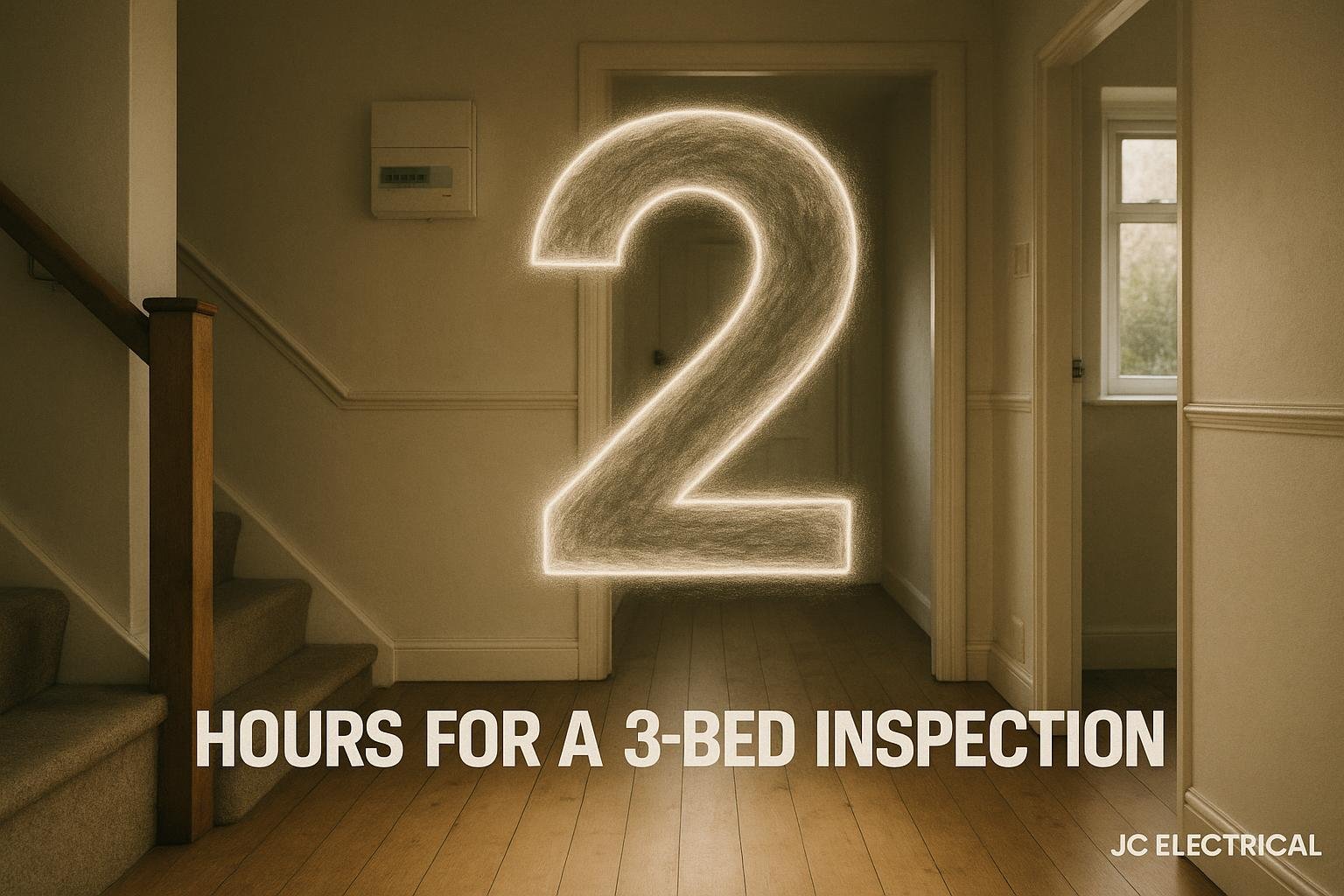
- Three bedrooms: the most common type, typically two to three hours
- Four bedrooms: allow three to four hours, sometimes more if there are outbuildings or a garage on a separate circuit
- Five bedrooms or larger: four hours or more, and the price rises accordingly
These are working times, not arrival-to-departure times. If the electrician has to move furniture to reach sockets, or if the consumer unit is in an awkward location, that adds time too.
What should you do before the electrician arrives?
The single most useful thing you can do is clear access to every socket, switch and light fitting. That means pulling sofas away from walls, moving things off shelves near switches, and making sure the consumer unit is easy to reach. If the electrician spends twenty minutes shifting furniture, that is twenty minutes on the clock. In a three-bedroom house in Beaconsfield, a bit of preparation can genuinely keep the job inside the lower end of the time estimate.
Also make sure someone is home throughout. The electrician needs to move through every room, and they will need to turn circuits off and on during testing. You do not need to follow them around, but you do need to be available.
What is the trap with cheap EICR websites?
Search for an EICR online and you will find sites offering certificates at prices that seem surprisingly low. Many of these are not electricians at all. They are lead-generation brokers: they take your booking and payment, then pass the job to a subcontractor, often whoever is available rather than whoever is best suited to your area. You have no control over who turns up, and the person on the doorstep may have no idea what the broker charged you. If remedial work is needed, the subcontractor sets their own price for that, and it may be very different from what you were expecting.
Booking directly with a local electrician means you know exactly who is coming, you can ask questions in advance, and if remedial work comes up you are dealing with the same person who did the inspection. That continuity matters, particularly if the report flags something significant.
How long does an EICR take, and what happens during it?
For a standard three-bedroom house, the inspection typically takes two to three hours. The electrician will work through the property systematically: checking the consumer unit first, then testing each circuit in turn. During testing, circuits are isolated one at a time, so some sockets and lights will be off for short periods. This is normal and expected.
The report itself is written up either on site or shortly afterwards. It will list any observations using a standard coding system. A code indicating immediate danger means the work needs doing before the certificate is valid. A code indicating a potential danger means the work is strongly recommended. Anything lower is an improvement recommendation rather than a safety issue.
In older properties across South Buckinghamshire, the most common findings involve the consumer unit. Older fuse boards without modern protective devices often generate a recommendation for an upgrade. If you are in a house built before the 1990s and the board has never been changed, it is worth being prepared for that conversation.
What happens if remedial work is needed?
If the report comes back with findings that need addressing, the cost of the EICR is only the starting point. Remedial work is priced separately, and the scope varies enormously. A loose connection or a missing earth bond might be a short, straightforward job. A consumer unit that needs replacing is a bigger piece of work. You can read more about what that involves on the page covering board upgrades and consumer unit replacements in Beaconsfield.
It is worth knowing that a registered electrician completing remedial work will issue their own certificate for that work. The EICR and the remedial certificate together form the paper trail that a landlord, mortgage lender or insurer may ask to see. Keep both documents somewhere safe.
Do landlords in Beaconsfield have to have an EICR?
Yes. If you rent out a property in England, you are required to have a valid EICR in place and to provide a copy to tenants. The certificate must be renewed every five years or at each change of tenancy, whichever comes sooner. New tenants must receive a copy before they move in, and existing tenants must receive a copy within a set period of a new certificate being issued. Local authorities can take action against landlords who do not comply.
For owner-occupiers, there is no legal requirement tied to a fixed interval, but most electricians recommend an inspection every ten years. If you are buying a property in Knotty Green, Wooburn Green or anywhere else in the area, asking for a recent EICR as part of the purchase process is sensible. If one is not available, budgeting for one before you move in gives you a clear picture of what you are taking on.
Is the cheapest quote always the worst option?
Not automatically, but a quote that is significantly below the range shown at the top of this page is worth questioning. Ask whether the person quoting is the person who will do the work. Ask what the quote covers if remedial work is found. Ask whether they are registered and able to issue the relevant certificates. A straightforward answer to all three is a good sign. Evasiveness is not.
The goal of an EICR is to give you an honest picture of the wiring in your home. A thorough inspection done properly takes time, and time costs money. An inspection that is rushed to hit a low price point may miss things, which defeats the purpose entirely.
If you have a property in Beaconsfield or the surrounding area and you need an EICR, send the details using the form on this page and Jess will come back to you with a straightforward quote. Include the number of bedrooms, whether the property is rented or owner-occupied, and roughly when the last inspection was done if you know it. The contact form and phone number are below.