
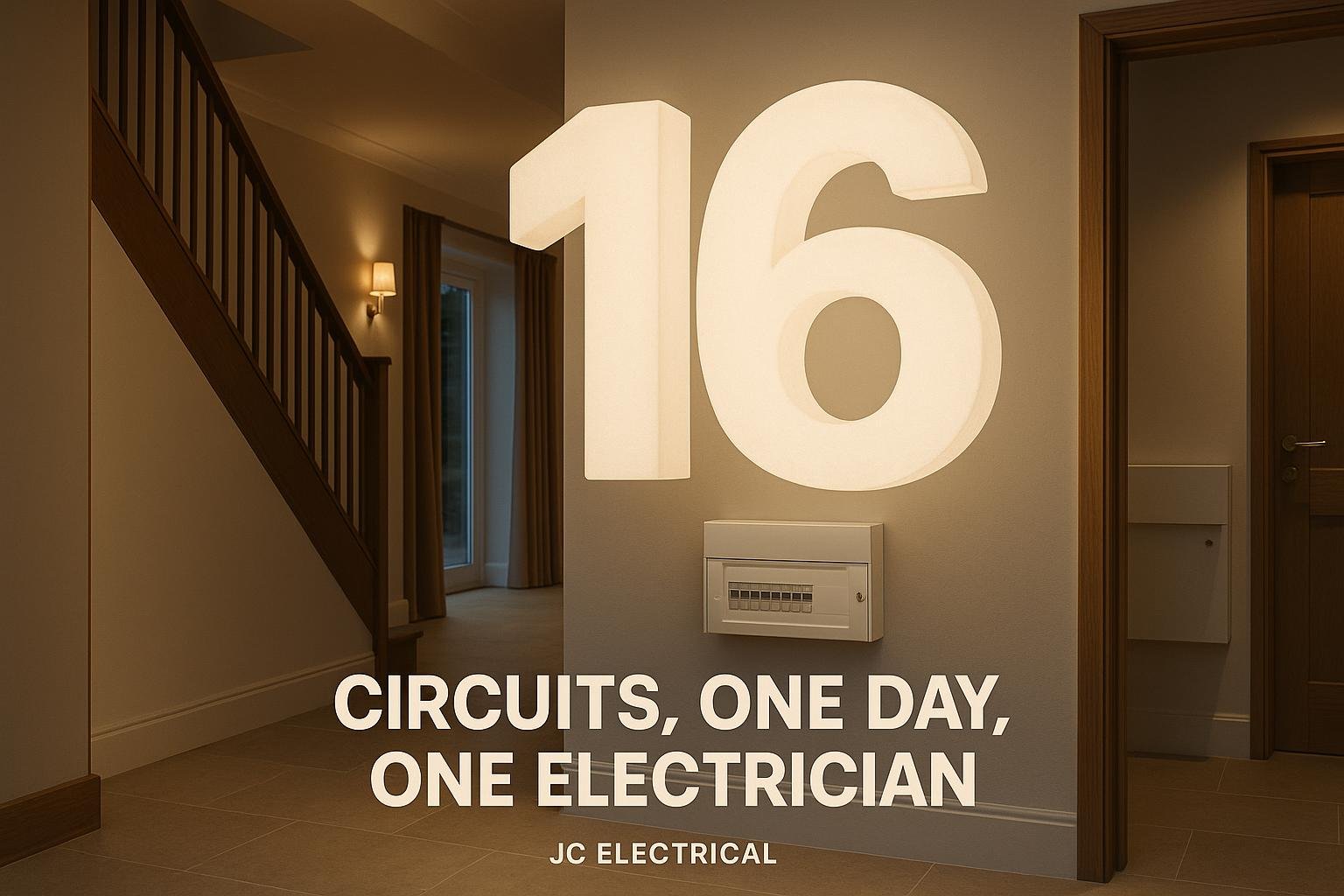
Your consumer unit, the box on the wall that most people still call the fuse box, controls every circuit in the house and is the first line of defence when something goes wrong. When it is working well you never think about it. When it is not, you notice quickly: nuisance tripping, a breaker that will not stay up, or a surveyor’s report that flags it as a problem before a house sale goes through. This guide explains what moves the price of a replacement, what a proper job includes, and how to read two quotes side by side so you know what you are actually being offered.
How do you know your consumer unit needs replacing?
The clearest sign is age. Boards fitted before the mid-2000s were built to older standards and often lack the protection that modern wiring regulations require. If yours has a row of rewirable fuses with actual fuse wire, it is overdue. If it has MCBs but no RCD protection at all, it will not meet current requirements for a notifiable installation.
Other signs are more immediate. A breaker that trips repeatedly on a circuit that is not overloaded suggests the breaker itself is failing. A board that runs warm to the touch, shows scorch marks, or smells faintly of burning needs attention now rather than later. Plastic enclosures that have gone brittle or yellowed are another indicator of age. A surveyor or mortgage lender flagging the board is a common trigger in Beaconsfield, where a lot of the housing stock dates from the 1960s and 1970s and the original boards have simply reached the end of their useful life.
How many ways does your house actually need?
A consumer unit is sold partly by the number of ways, meaning the number of circuit positions it holds. A small two-bedroom flat might manage on ten ways. A four-bedroom detached house with an electric shower, a separate cooker circuit, outdoor sockets, a garage and underfloor heating in the bathroom can easily need sixteen or more.
The number of circuits a house needs has crept up over the decades. Kitchens that once ran on a single ring main now often have a dedicated circuit for the oven, another for the hob, one for the dishwasher and one for the fridge, because modern appliances draw more current and a dedicated circuit protects each one properly. Extensions are a common trigger in areas like Penn and Knotty Green, where homeowners add a kitchen extension or a garden room and suddenly need two or three extra circuits the old board simply cannot accommodate. Fitting a board that is already full, or nearly full, is a false economy. A good electrician will size the new board to what you have now and leave a couple of spare ways for what you are likely to add in the next ten years.
RCBOs versus dual RCD: why it matters at six in the morning
This is one of the most practical decisions in the whole job, and it is worth understanding before you accept a quote.
An older-style board uses one or two RCDs to protect groups of circuits. If a fault develops on any circuit in that group, the shared RCD trips and everything in the group goes off together. At six in the morning that can mean losing the bedroom lights, the alarm clock and the landing socket all because the bathroom shaver socket developed a fault. You are then hunting in the dark for the right breaker.
An RCBO board gives every single circuit its own combined breaker and RCD. A fault on the bathroom circuit trips only that circuit. Everything else stays on. The board costs more in parts and takes longer to wire, which is reflected in the price, but for a family home it is a significantly better product. It is also the direction that wiring regulations have been moving for some years. When you see two quotes for the same board size and one is noticeably cheaper, the difference is often here: one is quoting dual RCD and the other is quoting full RCBO. Make sure you are comparing the same specification.
Earthing and bonding: the part people forget to budget for
Replacing the board is only part of the picture. Before a new unit can be certified, the earthing and main bonding must meet current standards. In many South Bucks houses built before plastic water mains became common, the earth was provided by the metal water pipe running into the house. Water companies have been replacing those metal mains with plastic for years, which breaks the earth path. The electrician must then install a proper earth electrode or confirm that the supply authority’s earth terminal is being used correctly.
Main bonding connects the incoming gas and water services to the earthing system. The cables used for this are larger than most homeowners expect, typically 10mm², and they need to be run from the services to the consumer unit in a way that is accessible and secure. In a house that has never had this done properly, or where it was done to an older standard, this can add a couple of hours to the job and require some minor making good. It is not optional. A registered electrician will not sign off a new board without confirming the earthing is sound, and you would not want them to.
Surge protection: who genuinely needs it?
A surge protection device, usually called an SPD, protects the circuits and the equipment connected to them from voltage spikes caused by lightning or switching events on the supply network. Current wiring regulations require electricians to consider SPD for new installations and to fit one or document a risk assessment explaining why one was not fitted.
For most domestic properties in Beaconsfield and the surrounding villages, the risk from lightning is low and the supply network is reasonably stable. An SPD adds cost to the job. It is worth having if you have expensive electronics, a home office with servers or specialist equipment, or if you live somewhere with an overhead supply line rather than an underground cable. For a typical suburban house with a standard underground supply, the honest answer is that it is a modest extra layer of protection rather than an essential. Ask your electrician to explain their reasoning either way rather than simply accepting or refusing it without discussion.
Does the board position affect the cost?
Most boards stay where they are. Moving a consumer unit is a more involved job than swapping it in place, because the meter tails, the earthing connections and sometimes the incoming supply cable all need to be extended or rerouted. The supply authority may need to be involved if the meter itself is moving.
That said, there are good reasons to move a board. A unit tucked inside a built-in cupboard with no ventilation, or positioned so that the meter reader cannot reach it, or sited in a damp utility room, is worth relocating if the opportunity arises. In older properties in Amersham or Gerrards Cross where the original board was fitted in a coal cellar or a tight understairs space, moving it to a more accessible hallway position can make future maintenance much easier. Get a clear breakdown of what the move involves before agreeing to it, because the labour involved varies considerably depending on how far the board is travelling and what is in the way.
What does a compliant installation actually include?
A consumer unit replacement is notifiable work. That means the electrician must either be registered with a competent person scheme or the work must be inspected and approved through your local building control. A registered electrician handles the notification themselves and you receive two documents: an electrical installation certificate and a building regulations completion certificate.
Before issuing those certificates, the electrician must test every circuit. That means checking insulation resistance, earth continuity and the correct operation of every protective device. It is not a quick visual check. On a house with twelve to sixteen circuits it takes a meaningful part of the working day. If a quote does not mention testing and certification, ask specifically what is included. For a full overview of what board upgrade work involves, see consumer unit and board upgrades in Beaconsfield.
How do you compare two quotes properly?
When you have two quotes in front of you, the headline figure is the least useful thing on the page. Work through these questions for each one.
- How many ways is the new board, and is that enough for your current circuits plus a couple of spare positions?
- Is the protection RCBO per circuit or dual RCD?
- Does the quote include testing and certification, or are those listed as extras?
- Does it include checking and upgrading the earthing and main bonding if needed, or is that a separate cost?
- Is surge protection included, and if so has the electrician explained why it is appropriate for your property?
- What happens if the electrician finds a circuit fault during testing? Is there an agreed day rate for additional work, or will you be called mid-job with a surprise figure?
A quote that answers all of those questions clearly is worth more than a lower number that leaves them open. A good electrician will not mind being asked.
If you are ready to go ahead or you just want a straight answer on what your job is likely to involve, send Jess the details using the form or number on this page and he will come back to you without any sales pressure.