
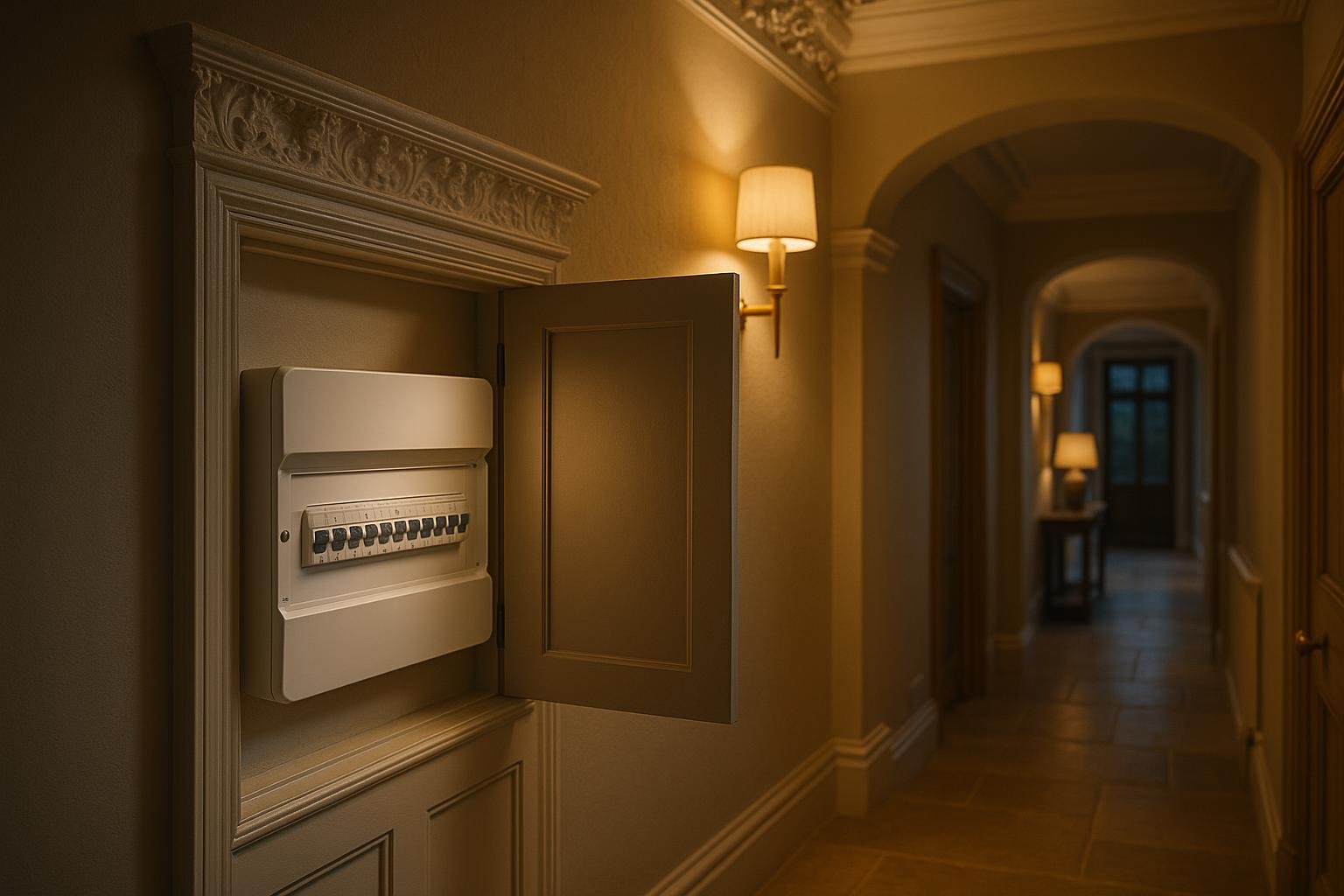
Most people only think about their fuse box when something goes wrong: a light that will not come back on, a socket that has stopped working, or a faint smell they cannot quite place. The box itself sits in a cupboard or a corner of the hallway and gets ignored for years. That is understandable, but it does mean that problems can build up quietly until they become urgent. This guide walks through the warning signs, explains which ones need attention today and which are advisory, and helps you decide whether a conversation with an electrician is overdue.
What does a modern consumer unit actually do?
The consumer unit, which most people still call the fuse box, sits between the meter and every circuit in your home. Its job is to protect those circuits: if a cable overheats or a fault develops, the relevant breaker trips and cuts the power before anything catches fire or anyone gets a shock. A modern board does this in two ways. Circuit breakers respond to overloads and short circuits. RCDs, the wider switches usually grouped on one side of the board, respond to earth faults, including the kind that can stop a heart in a fraction of a second. Both types of protection matter. An old board may have neither.
It is also worth understanding that the board does not just protect you from faults that already exist. It limits how bad things can get if a fault develops in the future, whether that is a nail through a cable during a DIY job, a washing machine motor that fails, or insulation that has degraded quietly over years. A board without proper protection does not fail to trip because nothing is wrong; it fails to trip when something is very wrong indeed, and by then the damage may already be done.
What are the signs that a fuse box is genuinely old?
The most obvious sign is the fuses themselves. If you open the board and see a row of small ceramic or porcelain cartridges with wire running through them, those are rewireable fuses. They were standard until the 1960s and 1970s. When one blows, someone has to replace the wire by hand, often with whatever wire came to hand, which is part of the problem. There is no guarantee the replacement wire is the right rating for the circuit. A lighting circuit fused at 5 amps that has been rewired with 15-amp fuse wire is no longer protected at all; it will carry far more current than the cable behind it was designed to handle before anything trips.
Look at the backing board too. If it is wood, or if it has a slightly grey, fibrous appearance that suggests older composite materials, the board is old enough that replacement is worth serious consideration. Modern consumer units are housed in non-combustible enclosures for a reason. A wooden back does not mean a fire is imminent, but it does mean that if arcing ever did occur inside the enclosure, there would be nothing to slow what happened next.
Finally, look for the RCD switches. On a modern board they are usually wider than the individual circuit breakers and sit in a group. If every switch on your board is the same narrow size, there may be no RCD protection at all. Some boards fitted in the 1980s and 1990s have a single RCD protecting everything, which is better than nothing but still leaves the whole house dark when a single fault trips it. A more modern split-load arrangement divides the circuits between two or more RCDs so that a fault on one group does not take out the other.
Which signs are urgent and which are advisory?
Some things need same-day attention. Scorch marks anywhere on the board, a smell of burning plastic or hot metal near the unit, a breaker that is warm to the touch, or a fuse that has clearly overheated: these are not things to monitor. They mean arcing or sustained overheating has already occurred. Switch off the affected circuit and call a registered electrician that day.
A breaker that trips and will not reset is also urgent, though in a different way. It is not dangerous in itself because the protection is doing its job, but it means there is an active fault somewhere on that circuit. Do not force the breaker. Switch off everything connected to it, try once more, and if it still will not hold, leave it off and get it looked at. A common misunderstanding here is that a breaker which keeps tripping is faulty and needs replacing. In most cases the breaker is working exactly as it should. The fault is on the circuit it protects, not in the breaker itself.
Advisory signs are things that are not immediately dangerous but that put your home outside what current standards expect. No RCD protection falls into this category. An old rewireable fuse board falls into this category. So does a board that has been in place since before a significant extension or conversion was added to the house. None of these is an emergency at midnight, but none of them should sit on the to-do list for years either.
What about a board that predates an extension or loft conversion?
This is a situation Jess sees regularly across Beaconsfield, Penn and the surrounding villages. A house was built in the 1960s or 1970s, the original board is still in place, and at some point an extension was added. The extension circuits were connected to whatever spare ways were available, sometimes by whoever was cheapest at the time. The result is a board that is full, possibly overloaded on some ways, and almost certainly without the RCD protection that the extension circuits should have.
A telling detail is the number of ways on the board versus the number of circuits in the house. A 1970s board might have had six or eight ways. A house that has since gained a kitchen extension, an electric shower, an outbuilding and a home office could easily need twelve circuits or more. When circuits have been doubled up on a single breaker to make them fit, the protection that breaker provides is now shared across twice as much cable as it was designed to cover. That is not a theoretical concern; it is the kind of arrangement that allows sustained overloading to go undetected.
If your board predates a significant piece of work on the house, it is worth having it assessed. The question is not just whether the board itself is safe, but whether the circuits added since were done properly and whether the board can still protect them as it should.
Does a new board mean I also need a rewire?
Not automatically. A consumer unit upgrade and a full rewire are separate jobs, and many houses in this area have perfectly sound wiring that will connect cleanly to a new board. Before any board upgrade, a competent electrician will check the condition of the existing cables. If the wiring is in good order, the board can be replaced on its own. If there are signs that the wiring itself is failing, that conversation needs to happen before the work starts, not after.
The check is not just a visual inspection of what is visible at the board. Each circuit is tested for insulation resistance and continuity, which reveals problems inside walls and under floors that no one could see by looking. A circuit that tests poorly may need remedial work before it can be safely connected to a new board. That is not a reason to delay the board replacement; it is a reason to get the assessment done so you know exactly what you are dealing with.
For a fuller picture of what a rewire involves and when it becomes necessary, the guide to full house rewires and board upgrades in Beaconsfield covers both in detail.
What happens during a board replacement?
The work typically takes one day for a standard house. The supply is isolated at the meter, the old board is disconnected and removed, and the new unit is fitted and connected circuit by circuit. Each circuit is tested before it is energised. At the end, the electrician issues a certificate confirming the installation meets current requirements. That certificate matters: your insurer may ask for it, and if you sell the house it forms part of the documentation a buyer’s solicitor will want to see.
One thing homeowners sometimes do not anticipate is that the supply cannot be isolated at the board itself. It has to be isolated at the meter, which means coordinating with the network operator if the meter does not have an isolator fitted. In most cases this is straightforward, but it is worth asking about during the initial conversation so there are no surprises on the day.
The range at the top of this page covers most domestic properties. Larger houses with more circuits, or properties where access to the board is awkward, tend to sit toward the upper end. The price also depends on whether any remedial work is needed on individual circuits before they can be connected to the new board.
What should I check before calling an electrician?
A few things are worth noting before you make contact, because they help the electrician give you an accurate picture quickly.
- How many circuits does your current board have, and are there any spare ways?
- When was the house built, and has it had any extensions or conversions since?
- Have any breakers or fuses been tripping repeatedly, and on which circuits?
- Is there any visible damage, scorching or discolouration on or near the board?
- Do you have any existing electrical certificates for the property?
If the board is in a cupboard or a utility room, it is also useful to note how easy it is to reach. A board tucked behind a shelving unit or above a boiler takes longer to work on safely, and that affects how long the job takes. You do not need to know the answers to all of these. But the more you can say, the more useful the first conversation will be.
Is there anything I can do myself?
Very little, and that is not a cautious answer, it is an honest one. Consumer units sit on the supply side of your installation. Working on them without isolating the meter supply is genuinely dangerous, and isolating the meter supply is not something a homeowner can do. The board replacement itself, the testing, and the certification all require a registered electrician. What you can do is keep an eye on the signs described above, note anything that changes, and make the call before a small problem becomes a large one.
If your board is showing any of the warning signs in this guide, or if you simply are not sure how old it is or what protection it has, send the details of your property and what you have noticed using the form on this page. Jess covers Beaconsfield, Amersham, Gerrards Cross, Marlow, High Wycombe and the surrounding area, and will give you a straight answer about what, if anything, needs doing.