
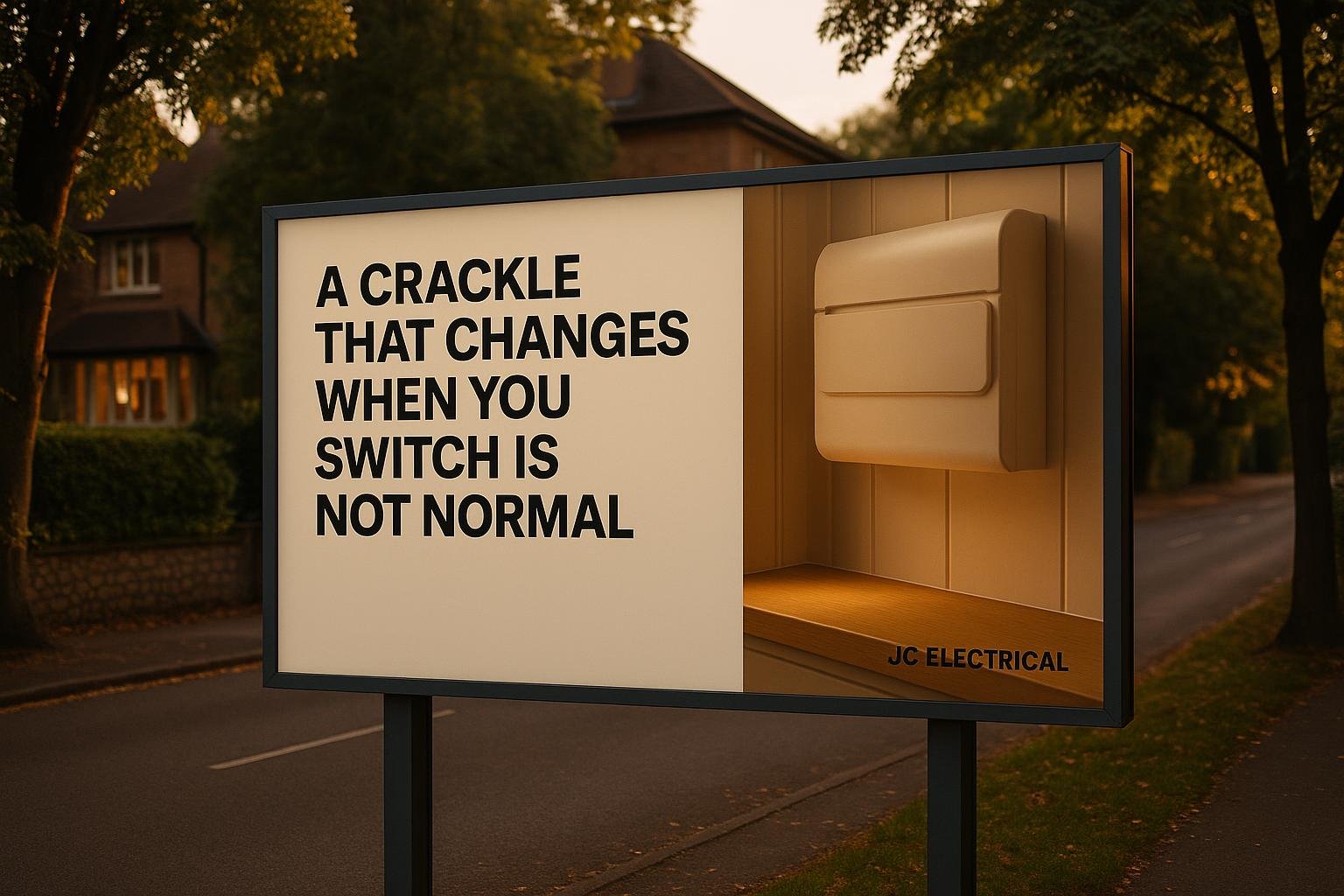
A noise coming from your fuse box is one of those things that is easy to dismiss but hard to stop thinking about. Sometimes it really is nothing: a steady, faint hum that has always been there and never causes any trouble. Other times it is the first sign that something inside the board has worked loose and is arcing. Knowing which is which means you can sleep at night rather than lie awake worrying, or, if there is a real problem, get it sorted before it becomes dangerous.
What makes a fuse box hum in the first place?
The mains supply in the UK runs at 50 Hz, which means the current reverses direction fifty times every second. Transformers, relays and contactors all vibrate slightly in response to that frequency, and the vibration turns into an audible hum. Inside a modern consumer unit there are components that do the same thing: RCDs and RCBOs contain small coils, and these can produce a faint 50 Hz tone, especially if the board is carrying a heavy load. That kind of hum is steady, low-pitched, and does not change when you switch things on or off in the house. It has been there since the board was installed and it does not get louder over time.
Doorbell transformers are a common culprit that people overlook. They are often tucked behind the front door or in a cupboard very close to where the consumer unit sits, and their hum travels through the wall and sounds as though it is coming from the board. The same is true of old-style heating contactors, which click and hum when the programmer calls for heat. A useful test is to turn your heating programmer to off and listen again after a few minutes. If the hum disappears or drops noticeably, the contactor was almost certainly the source. Similarly, pressing the doorbell button while a second person listens at the board can confirm or rule out the doorbell transformer in a matter of seconds.
Another source that catches people out is an electric vehicle charger or a heat pump installed in the last year or two. Both introduce higher harmonic currents into the domestic circuit, and these can excite the coils in RCDs or RCBOs that never made a sound before. If the hum started shortly after a new piece of equipment was connected to the house, tell the electrician that detail: it changes where they look first.
What does a worrying noise sound like?
The noise that should make you act is different in character from the steady hum described above. It crackles, spits or buzzes unevenly, and, crucially, it changes when you switch things on or off or plug an appliance in. That kind of sound suggests arcing: electricity jumping across a gap where there should be solid contact. Loose terminals, a wire that has worked its way out of a connector, or a corroded busbar connection can all produce arcing. Arcing generates heat, and heat in an enclosed plastic enclosure is a fire risk.
You might also notice a slight sizzling or hissing rather than a pure hum. Some people describe it as the sound of a bad radio connection. If the noise rises and falls with the load on the circuit, that is a strong signal that something physical has come loose inside the board or in a connection immediately upstream of it.
A common misunderstanding is that arcing must be loud to be dangerous. In practice, the early stages of a failing terminal connection can produce a noise barely louder than the background hum, but the heat it generates is already doing damage. The sound only becomes dramatic once the fault is well advanced. This is why warmth, smell and discolouration matter at least as much as volume when you are deciding whether to act.
How to listen safely without opening anything
Stand close to the consumer unit and listen carefully with the house as quiet as possible. Turn off the television, the radio and anything else that makes background noise. Then, one at a time, switch off circuits at the board using the individual breakers and listen whether the sound changes. Do not remove the cover. The live cables coming in from the meter are always live even when the main switch inside the board is off, and the busbars at the top of the unit can cause a serious shock or a flash. This is not a job for a screwdriver.
If the noise disappears when you turn off a particular circuit, you have useful information to pass on to the electrician. Make a note of which breaker it was and what that circuit supplies, whether that is sockets in one room, the cooker, or the immersion heater. If the sound stays the same regardless of what you switch, it is more likely to be a low-level transformer hum than a connection fault.
While you are listening, hold the back of your hand near the front cover of the board without touching it. If you can feel warmth radiating from the plastic, that changes the urgency of the situation even if the noise itself seems mild.
When should I call an electrician the same day?
There are four things that, individually or together, should make you pick up the phone without waiting:
- The board or the area around it feels warm to the touch.
- There is any smell of burning, hot plastic or an acrid electrical smell.
- You can see discolouration, scorch marks or a brown tinge on the plastic front of the unit.
- The crackling noise is clearly getting worse or changes sharply when you switch something on.
Any one of these puts the problem into a different category. A steady, cool, odourless hum that has been present for weeks without changing can wait until a convenient appointment. Warmth and smell cannot. In Beaconsfield and the surrounding villages, summer and winter both bring periods of high load on domestic boards, and a connection that is just starting to fail will often get worse quickly once it begins to heat up.
Another thing worth knowing: a board that has tripped repeatedly in the weeks before the buzzing started is worth mentioning to the electrician. Repeated trips can loosen terminals slightly each time the breaker mechanism operates, and a board that has been working harder than usual is more likely to have a connection under stress.
What will an electrician actually do?
A registered electrician will start by asking you to describe the noise and when it started. That conversation alone often narrows the diagnosis considerably. They will then switch off circuits one at a time while listening, and use a thermal imaging camera or a clamp meter to check for hot spots on the busbars and terminals. If a wire has worked loose in a terminal, they will tighten or replace it. If a breaker is showing signs of internal damage, they will swap it out. The whole visit is usually straightforward when the problem is a single loose connection.
If the thermal camera picks up a hot spot on a busbar rather than an individual terminal, that points to a slightly different problem: the main busbar itself may be corroded or the connection to it may have been disturbed at some point. That is still a fixable issue, but it requires more care to access safely and may mean the supply needs to be isolated at the meter, which involves notifying the network operator. A good electrician will explain what they find and why a particular repair takes the time it does.
If the inspection shows that the board is old, lacks proper RCD protection across all circuits, or has been modified badly over the years, the electrician will explain what they found and what the options are. A replacement board is a bigger job, and you can read more about what that involves on the consumer unit and board upgrade service page. The range at the top of this page gives a realistic guide to what a full board replacement costs for a typical Beaconsfield or Amersham home.
What about older boards and older wiring?
Houses in Penn, Knotty Green and the older parts of High Wycombe often have boards that are twenty or thirty years old. An old board with ceramic fuses or early-generation MCBs can develop loose connections simply through age: the plastic becomes brittle, terminals work loose over many cycles of heating and cooling, and the spring tension in some older breakers weakens. A faint hum from one of these boards is worth investigating even if there is no smell or warmth, because the inspection may find problems that are not yet producing obvious symptoms.
There is also a difference between a board that has always hummed and one that has started humming recently. An old board that suddenly develops a noise it never had before deserves more urgency than one where the owner can recall the sound being present for years. If you moved into the property recently and cannot be certain when the noise started, err on the side of having it checked sooner.
If you have rubber-sheathed or aluminium wiring anywhere in the house, tell the electrician before they visit. That affects how they approach the work and what they recommend.
Can I reduce the hum myself while I wait for the appointment?
Not really, and you should not try to. What you can do is make sure the area around the consumer unit is clear, that nothing flammable is stored nearby, and that a smoke alarm is working in the same area. Some people tape a note to the board to remind other household members not to touch it. If the noise suddenly gets much louder, or if you smell burning, do not wait for the appointment: switch off at the main switch if it is safe to reach, and call immediately.
Beyond that, the most useful thing is to write down what you noticed and when, which circuits you turned off during your listening test, and whether anything changed in the house around the time the noise started (a new appliance, a tripped breaker that was reset, a power cut). That information helps the electrician work faster and avoids the need to repeat the diagnostic steps you have already done.
Getting the right help
Most buzzing fuse boxes turn out to be either a harmless transformer hum or a single loose terminal that takes less than an hour to sort. A small number are the early warning of something that needs more work. The only way to know which category yours falls into is to have someone qualified look at it.
If you are in Beaconsfield, Amersham, Gerrards Cross, Marlow or anywhere else in South Buckinghamshire, send the details of what you are hearing using the form or number on this page and Jess will get back to you to arrange a visit at a time that suits you.