
Getting an EICR back with the word “unsatisfactory” printed across the front is a sinking feeling. Whether you are a homeowner in Penn or a landlord letting a flat in Beaconsfield, your first question is usually the same: how bad is this, and what does it cost to fix? The good news is that an unsatisfactory result does not automatically mean a rewire. In the majority of cases, targeted remedial work, sometimes just a few hours on site, is all that is needed to bring the installation up to scratch.
What do the codes actually mean?
An EICR uses a simple coding system to describe each fault or observation the electrician finds. There are three codes, and understanding what each one means takes the alarm out of reading the report.
A C1 is the most serious. It stands for “danger present” and means there is an immediate risk of injury. A live conductor with no insulation, an exposed terminal in a socket, a missing earth on a metal fitting, these are the sorts of things that earn a C1. When a C1 is found the electrician is expected to make it safe before leaving, or at the very least to isolate the circuit so the hazard cannot be touched. C1 codes are not common in ordinary homes, but when they appear they need sorting the same day.
A C2 means “potentially dangerous”. There is no immediate risk, but if the situation were to develop, for example if a fault developed on an unearthed appliance, there could be a serious outcome. A C2 causes the report to be marked unsatisfactory. Both C1 and C2 must be fixed before the installation can be signed off.
A C3 is a recommendation. It means the electrician has noticed something that does not meet today’s standards but is not currently dangerous. A C3 on its own does not fail the report. It is still worth addressing, but there is no legal obligation to do so.
What does a C2 look like in a real house?
Take a 1960s semi in Penn. These houses are solid and well-built, but their original electrical installations were designed around the habits of a generation that owned far fewer appliances. A typical EICR on one of these properties might raise several C2 codes.
The most common is a lack of RCD protection. The original fuseboard, often a rewirable fuse unit with ceramic carriers, has no residual current device. Under today’s standards, circuits supplying sockets and certain fixed appliances should be protected by an RCD, which cuts the power within milliseconds if it detects current leaking to earth through a person. Without one, a fault could deliver a lethal shock before any fuse blows. That is a C2.
Another common C2 on older properties is inadequate protective bonding. The gas and water pipes entering the house should be connected to the earth system with a bonding conductor of the right size. In many 1960s installations this bonding is either missing or done in cable that is too small for current standards. Again, the fault is not immediately dangerous, but in the wrong circumstances it could become so.
A third C2 that comes up regularly is the absence of an earthing conductor on a metal light fitting or a bathroom fixture. The fitting works perfectly well day to day, but if a fault developed inside the fitting and there was no path to earth, the metalwork could become live.
Does a C2 mean I need a full rewire?
Rarely. The codes listed above are all fixable without touching the cables in the walls. A missing bonding conductor is an afternoon’s work. An unearthed light fitting is usually fixed in under an hour. The cables in the walls of a 1960s Penn semi, if they are PVC-insulated twin-and-earth in reasonable condition, are not automatically condemned by an EICR. The report will only raise concerns about the cables themselves if the inspector finds cracking, overheating, or evidence of damage.
A full rewire becomes necessary when the cables are genuinely life-expired, typically rubber-insulated wiring from before the 1960s, or when there is such extensive rodent damage or DIY interference that the cable routes cannot be relied upon. That is a different conversation, and you can read more about it on the board upgrades and electrical installation pages for Beaconsfield.
How does a consumer unit upgrade clear several codes at once?
This is worth understanding because it changes the economics of remedial work. If an EICR has raised a C2 for no RCD protection, a C2 for an inadequate main earth, and a C2 for missing circuit identification, all three of those issues are addressed in one job when the old fuseboard is replaced with a modern consumer unit.
A new consumer unit comes with RCDs or RCBO protection built in, a properly sized earth terminal, and clearly labelled circuit breakers for every circuit. The electrician connects the existing cables to the new unit, tests each circuit, and issues a certificate for the upgrade. The original EICR is then endorsed as the remedial work having been completed. One visit, one certificate, three codes cleared.
For properties in Beaconsfield and across South Buckinghamshire, this is often the most sensible route when the fuseboard is already thirty or forty years old, because even if only two or three codes have been raised now, the board will continue to generate observations at every future inspection until it is replaced.
What happens after the remedial work is done?
This catches people out. You do not need a brand new EICR. The electrician who does the remedial work issues the appropriate certificate for that work, either a Minor Electrical Installation Works Certificate for small jobs or an Electrical Installation Certificate for larger work such as a consumer unit replacement. That certificate is attached to the original EICR and the report is updated to satisfactory.
If you are a landlord, you then send a copy of the completion evidence to your tenant, and to the local housing authority if they have asked for it. The next full EICR is due on the normal cycle, which for most rented properties is every five years.
What is the 28-day rule for landlords?
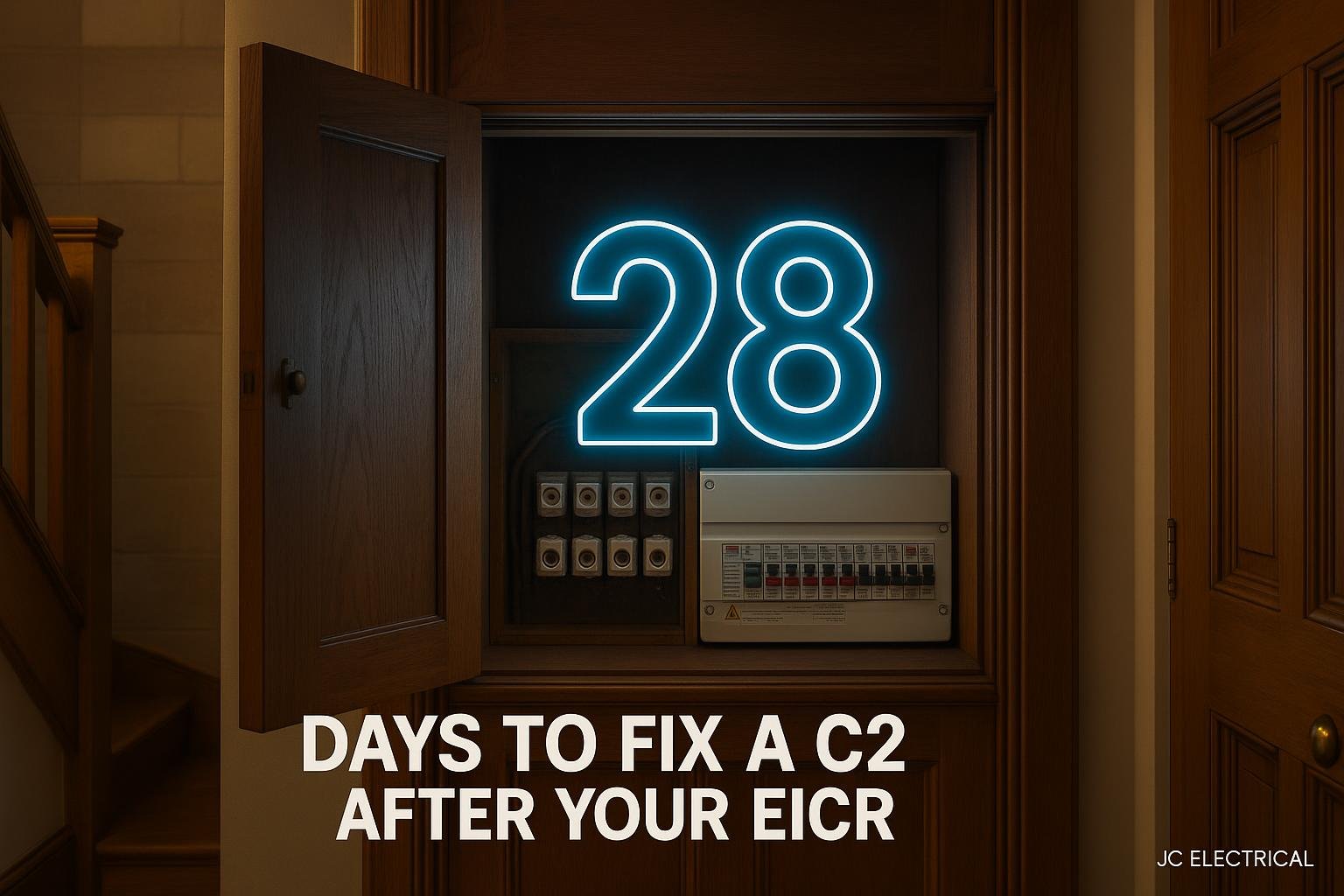
Landlords have a legal obligation to act on an unsatisfactory EICR within 28 days of receiving the report. If the report specifies that a hazard is more urgent, the timescale is whatever the report states, which could be 24 hours for a C1. The 28-day clock starts from the date of the report, not from the date you get around to reading it.
Once the work is done, you must provide written confirmation to the tenant within 28 days of completing it, along with a copy of the certificate. Failure to do this can result in the local authority serving a remedial notice. In Beaconsfield and the surrounding area, if a tenant complains to Buckinghamshire Council, the council can arrange the work itself and recover the cost from the landlord, so it is far better to deal with it promptly.
How much should I expect to pay?
The range at the top of this page reflects the most common remedial scenarios: bonding, an RCD retrofit, or a full consumer unit upgrade. Where only one or two small items need fixing, the cost sits at the lower end. Where several C2 codes point to a board replacement as the most efficient solution, the cost moves toward the middle or upper part of that range. A full rewire, if it were genuinely needed, would be a separate and larger conversation.
The most important thing is to get a clear written scope from the electrician before any work starts. A good remedial quote will list each code from the report, describe what work addresses it, and confirm that the completion certificate will be issued afterwards. That way you know exactly what you are paying for and can confirm the EICR will be signed off at the end.
What should I do next?
If you have received an unsatisfactory EICR on a property in Beaconsfield, Penn, Gerrards Cross, Amersham or anywhere else in South Buckinghamshire, send the details of the report using the form on this page. Jess will look at the codes raised and give you a straight assessment of what is needed, how long it will take, and what it will cost.