When a homeowner in Beaconsfield or Gerrards Cross asks about getting an EV charger fitted, the first thing many installers say is that they need a new consumer unit. Sometimes that is true. Sometimes it is not. This guide walks through the three practical tests that decide the answer, so you know before anyone arrives on your doorstep what to expect and why.
What is the consumer unit actually doing in this situation?
The consumer unit, sometimes still called the fuse box, is the hub that takes your incoming supply and splits it into separate protected circuits around the house. Every new circuit, including a dedicated EV charger circuit, needs a way into that board and it needs to be protected against fault current and earth leakage. Those two requirements are what the three tests below are checking. If your board already satisfies them, the charger can usually go in without touching the board at all. If it fails any one of them, some work on the board is needed before the charger is connected.
It is worth saying plainly: an EV charger draws a sustained load for several hours at a time, often overnight. That steady, high current is different from a kettle that runs for three minutes. The circuit serving it needs to be properly rated and properly protected, which is why the board question matters.
Test one: does your board have RCD protection?
An RCD, a residual current device, monitors the balance of current flowing in and out of a circuit. If there is a difference, it trips within milliseconds, protecting against electric shock and reducing fire risk. Modern boards either have a whole-board RCD or split the circuits between two RCDs so that a trip on one side does not cut power to everything.
For an EV charger circuit, RCD protection is required. If your board already covers all circuits with an RCD, this test is passed. If the board has no RCD at all, which is common in older split-load boards where only some circuits are covered, the new charger circuit can still be added cleanly. The electrician fits an RCBO (a combined circuit breaker and RCD in a single unit) on that one circuit, which gives the charger its own protection without needing a new board. That is a relatively straightforward addition.
The only situation where an RCBO workaround becomes tricky is if the board is so old or so full that there is physically nowhere to fit one, which brings us to test two.
Test two: is there a spare way on the board?
A consumer unit has a fixed number of slots, called ways, for circuit breakers. A typical domestic board has between eight and sixteen ways. If every slot is taken and there is no way to create space, the new charger circuit has nowhere to land. The board then needs to be replaced with one that has enough capacity.
Before assuming the worst, ask your electrician to look at what is actually in the board. It is common to find a slot tied up by a circuit that no longer exists, a redundant immersion heater feed, or two circuits that could reasonably share a twin breaker. A thorough check sometimes reveals a spare way that was not obvious at first glance. That ten-minute inspection can save the cost of a full board upgrade.
If there genuinely is no room, a new board is the right answer rather than a workaround. Adding a charger circuit via a sub-board or extension tacked onto an already full panel is not good practice.
Test three: does the board still use wire fuses?
This is the one test that produces a firm answer almost every time. If your board has the old rewirable wire fuse carriers rather than modern miniature circuit breakers, the answer to the whole question is yes, you need a new consumer unit before the EV charger goes in.
Wire fuse boards are old enough that any competent registered electrician will be uncomfortable adding a new high-load circuit to one. They offer no RCD protection, the fuse ratings are often uncertain after years of owner interference, and they do not trip cleanly under fault conditions the way a modern breaker does. The board upgrade is the right thing to do first, not an upsell.
For more on what is involved in replacing a board, including what the work covers and what to look for when comparing quotes, the board upgrades page for Beaconsfield and the surrounding area covers the detail.
What happens if the board passes all three tests?
If your board has adequate RCD coverage, has a spare way, and uses modern breakers, the EV charger can almost always be connected by running a new dedicated circuit directly from the board. The board itself is left alone. The work is then the cable run from the board to wherever the charger is being mounted, the charger unit itself, and the connection at both ends.
This is genuinely the most common outcome in homes built in Amersham, Marlow, Burnham and surrounding villages from the late 1990s onwards, where consumer units were already fitted with modern breakers and at least one RCD. Plenty of homes in High Wycombe and Chalfont St Peter have boards in good shape that need no work at all before a charger goes in.
What if the board needs work but the charger does not need to wait?
Sometimes a homeowner wants the charger fitted as soon as possible and is surprised to hear that board work comes first. The practical reality is that the board work and the charger installation can usually be booked together as a single visit. A straightforward board swap followed by the charger circuit and the charger unit itself is a full day’s work but it is one day, not two separate appointments spread across weeks.
If the board is in a difficult location, say inside a cupboard that needs clearing out, or if the incoming tails need extending as part of the upgrade, the job may run longer. Your electrician should walk you through what they find when they assess the board and give you a clear idea of the timeline before any work starts.
Does the supply itself need checking?
Fitting a new consumer unit does not increase the capacity of your incoming supply. The service fuse at the meter, supplied by your network operator, limits how much current the property can draw in total. A new board manages that supply more safely and flexibly, but it does not change the number. If your supply is a genuinely old or undersized service, that is a conversation with your network operator before the charger goes in, not something the electrician can resolve at the board.
For most homes in this part of Buckinghamshire, the supply is adequate for a standard 7kW home charger. But if you have a property with a very old meter installation, or if you are planning to run multiple high-load appliances alongside the charger, it is worth asking the question up front rather than discovering a limitation on installation day.
What about notification and certificates?
EV charger installation is notifiable work. A registered electrician self-certifies the installation and issues a certificate when the job is done. If a board upgrade is part of the same job, that is notifiable too and covered by the same certification process. You do not need to contact the council yourself when a registered electrician is doing the work. The certificate they issue is what your insurer and any future buyer will ask to see, so make sure you receive it and keep it with your property paperwork.
If you are combining this with an EV charger grant application through the government’s scheme, check the eligibility requirements before the installation date, as some conditions apply to the charger unit and its mounting location.
How do I find out where my board stands?
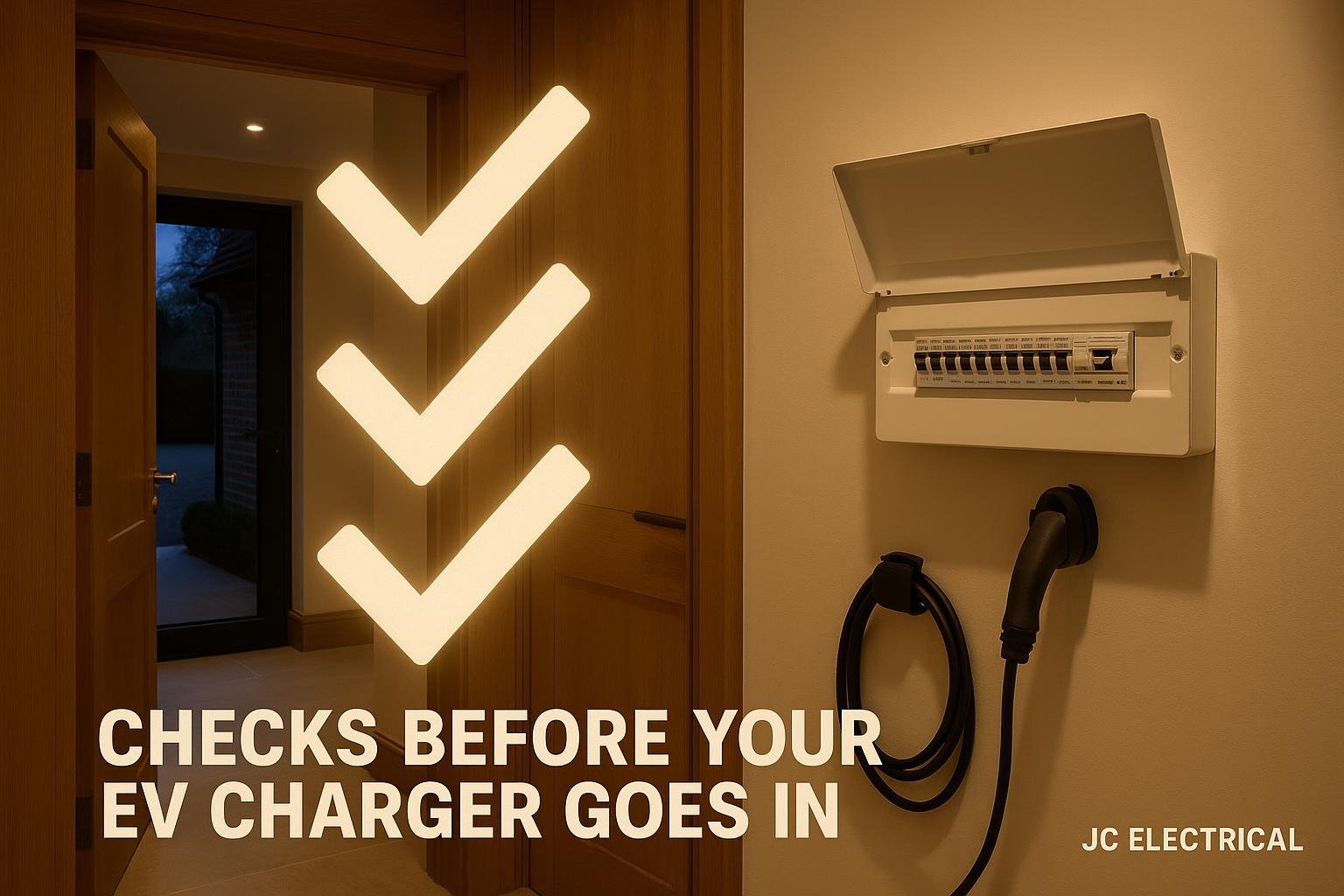
The fastest way is a quick visual check before you call anyone. Open the consumer unit cover (the door, not the cover over the wiring) and look at what is inside. If you see a row of small square or rectangular switches, you have circuit breakers. If you see coloured ceramic or plastic carriers that pull out, you have wire fuses. If there is a larger switch at one end or split into two halves with a switch on each, those are your RCDs. Count the spare slots if there are any. Taking a photograph and sending it across when you get in touch means the conversation can start in the right place.
If you are in Beaconsfield, Penn, Wooburn Green or anywhere else in this part of Buckinghamshire and want a straight answer on whether your board needs replacing before an EV charger goes in, send through the details of your job using the form or number on this page and Jess will give you an honest assessment.