
Buying an electric car is straightforward enough. Working out what it will actually cost to charge it at home is where people get confused. The headline price you see advertised for a charger unit rarely tells the full story, because the installation is where most of the variation happens. This guide walks through what a 7kW home charger installation genuinely involves in Beaconsfield and the surrounding villages, and what pushes the final number up or down.
What does a standard 7kW installation actually include?
A 7kW charger is the right choice for almost every home. It runs on a single-phase 32-amp circuit and will fully charge most electric cars overnight. The job involves supplying and fitting the charger unit itself, running a dedicated circuit from your consumer unit, installing a suitable isolator, testing the whole installation and issuing the electrician’s certificate.
That certificate matters. It is the document that proves the work was done to the current wiring regulations, and your insurer may ask for it if you ever make a claim involving the car or the property. Without it, you have no record that the circuit was installed correctly.
The price shown at the top of this page covers a straightforward installation: a charger on an outside wall, a cable run of reasonable length, and a consumer unit that already has a spare way. Most jobs in detached and semi-detached houses in Beaconsfield, Penn and Gerrards Cross fall somewhere in that range. A useful way to picture a straightforward job is a modern house where the consumer unit sits in a hallway cupboard close to the front of the property, the parking is on a driveway directly outside, and the cable can run through the wall and along the exterior in surface-mounted trunking. That kind of installation is typically done in half a day. What makes a job more complex is any combination of a longer route, a board that needs attention, or a DNO involvement, each of which adds time and sometimes materials.
What are the three things that move the price?
Three factors account for nearly all the variation you will see between quotes.
The first is the consumer unit. If your board is modern, has a free way and can carry the extra 32-amp load, the charger simply connects to it. If the board is old, full or undersized, it needs attention before the charger can go in safely. A board upgrade is a separate job with its own cost, and it is worth understanding that before you budget. You can read more about what that involves on the consumer unit upgrade and board upgrade page.
The second is cable length. The cable from the consumer unit to the charger has to be sized correctly for the load and the run. A short run inside a garage is quick and cheap. A long run across a house, under a path or along an external wall takes more time and more material. On some properties in older parts of Amersham or on larger plots in Knotty Green, the run can be surprisingly long. Cable sizing is not just about distance either: a longer run requires a larger cross-section of conductor to keep voltage drop within the limits set by the wiring regulations. That means the cable itself costs more per metre on a long run, not just the labour to install it. If a trench has to be dug to take the cable under a path or across a lawn, that adds further time and usually means reinstatement of the surface afterwards.
The third is the DNO, which is the company that owns the cables and transformer supplying your street. On most properties the existing 100-amp main fuse is adequate. On some older properties, or where several high-demand appliances are already running, the DNO may need to upgrade the cut-out fuse before the charger can be connected. This is arranged by the electrician, but the DNO sets its own timescale and sometimes its own charge. It is worth asking the electrician at the quoting stage whether they think a DNO application is likely, because it can add several weeks to the overall timeline even when the electrical work itself is straightforward.
Does the OZEV grant apply to my house?
This is one of the most common points of confusion. The government grant that helps with home charger costs is not available to everyone. Owners of detached houses are not currently eligible. The grant is aimed at renters and flat owners who meet specific criteria, and the property and tenancy have to qualify, not just the car.
If you rent, or if you own a flat, it is worth checking eligibility before you commit to a unit or an installer. A registered electrician who installs chargers regularly will know the current position and can tell you quickly whether your property qualifies. Do not assume the grant applies just because someone mentions it in passing.
A common misunderstanding is that the grant reduces the cost for anyone buying an electric car for the first time. It does not work that way. The eligibility rules are about the type of property and the occupancy arrangement, not the vehicle or the driver. A homeowner in a detached house in Beaconsfield who has just bought a new electric car will not qualify, regardless of income or circumstances. Checking this early avoids the frustration of budgeting with a discount that turns out not to apply.
Tethered or untethered: does it change the cost?
The short answer is not much, though the units themselves can differ in price.
A tethered charger has a cable permanently fixed to it. You walk out, pick up the cable and plug into the car. It is simple and fast, and it suits most households with a single electric car. The downside is that if you change to a car with a different connector type in future, you may need a new cable or a new unit.
An untethered charger has a socket on the front. You bring your own cable and plug one end into the charger and the other into the car. It is slightly more flexible if you have two cars with different connectors, but it means keeping a cable somewhere accessible.
For most families in Beaconsfield with one car, tethered is the more convenient choice. It is worth having the conversation with the electrician at the quoting stage rather than after the unit has been ordered.
What about smart charger rules?
Current regulations require any new home charger to be a smart charger. In practice this means the unit has to be able to communicate with the grid, allow you to schedule charging and respond to signals about grid demand. Every charger a registered electrician supplies today meets this requirement, so it is not something you need to research separately. It is simply part of what you get.
The practical benefit for most people is the ability to set the charger to run overnight on a cheaper tariff. Over the course of a year that can make a real difference to running costs, and it is one of the main reasons a dedicated home charger makes more sense than using a three-pin plug.
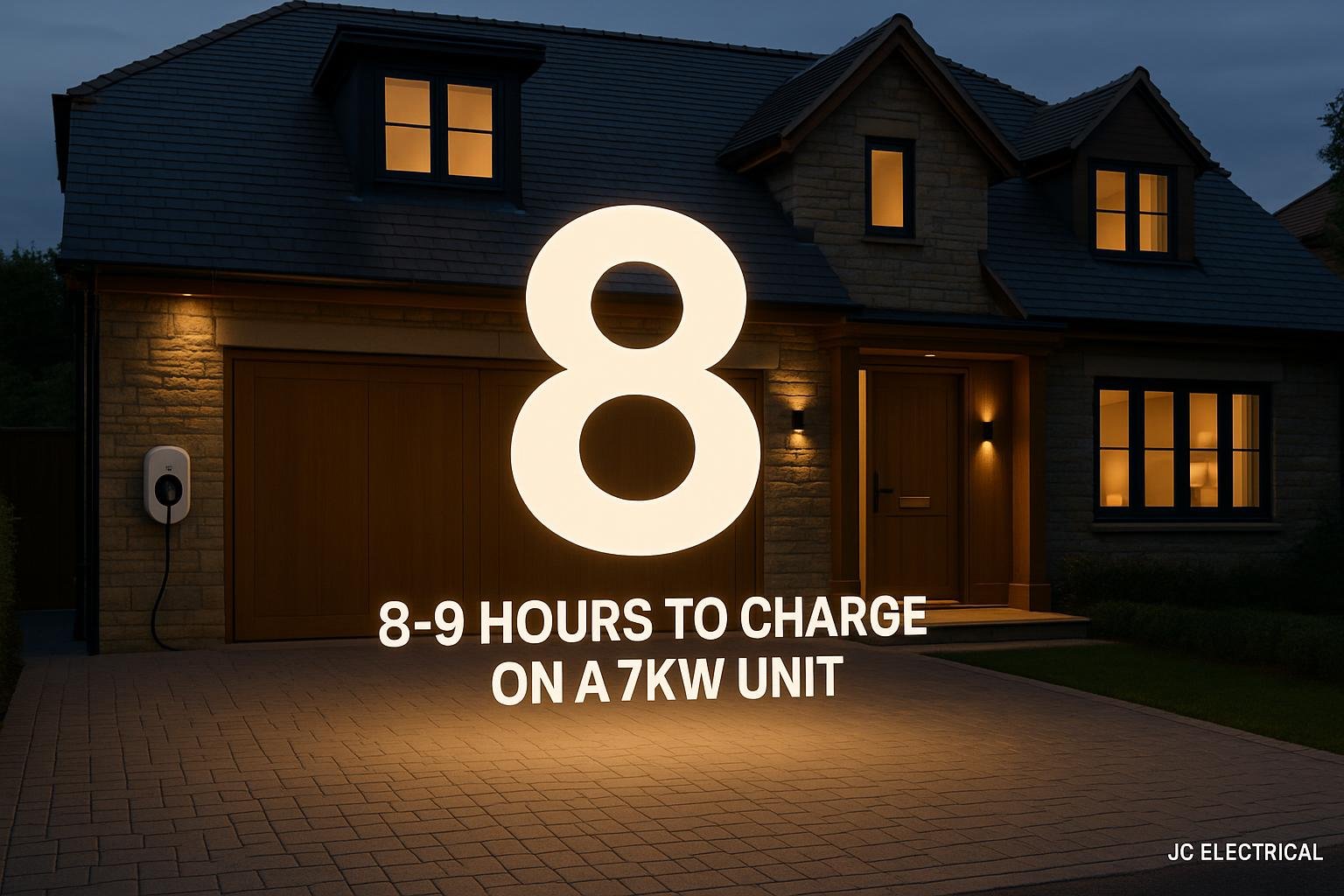
A three-pin plug delivers around 2.3kW, which means a car with a 60kWh battery takes over 24 hours to charge from empty. A 7kW charger cuts that to around eight or nine hours, which fits neatly into an overnight window. That is the practical case for installing a proper charger rather than relying on the cable that comes in the boot of the car.
Can I use my charger with solar panels?
If you have solar panels on the roof, or you are planning to install them, it is worth mentioning this before the charger is specified. Certain charger models are designed to detect surplus energy being generated by the panels and prioritise sending that to the car before it exports to the grid or before drawing from the grid at all.
One type of unit that does this is sometimes called a solar-optimising or eco-charging unit. The brand name Zappi is the one most commonly associated with this approach. These units cost a little more than a basic smart charger, but on a property with a reasonably sized solar array the additional cost can pay back over time through reduced grid use.
If solar is part of your thinking, raise it at the quoting stage. Fitting a standard charger now and swapping it later is a waste of money. Getting the right unit first time is straightforward if the electrician knows what you are planning.
What should I check before getting a quote?
A few things are worth looking at before an electrician visits, because they affect the quote directly.
Where is your consumer unit? If it is in a hallway near the front of the house and your parking is at the front, the cable run is short. If the board is at the back and the car parks at the side, the run is longer.
How old is the board? If it is a rewireable fuse board rather than a modern circuit-breaker board, it will almost certainly need replacing before a charger can be added. A board with miniature circuit breakers but no residual current device protection may also need upgrading, since the charger circuit requires a specific type of protective device that older boards may not accommodate without modification.
Is there a clear route for the cable? Through a garage wall, along a soffit, under a path: the easier the route, the lower the cost. If you can identify a route that avoids digging or significant surface reinstatement, mention it when the electrician visits. Sometimes a slightly longer route that stays above ground is cheaper overall than a shorter one that requires groundworks.
What does your electricity supplier offer? Some tariffs are designed specifically for EV owners and charge less per unit overnight. Switching before the charger is installed means you are ready to benefit from day one.
None of this requires specialist knowledge. Walking around your own property and noting the distances and obstacles takes ten minutes and means the electrician can give you a more accurate price at the first visit.
How do I get a price for my property?
Every installation is different enough that a fixed online price is rarely reliable. The best approach is to describe your property, the location of the consumer unit and where you park, and let the electrician assess the job properly.
If you are in Beaconsfield, Wooburn Green, Burnham, Marlow or any of the other areas Jess covers, use the contact form or phone number on this page to send the details. A site visit is usually the quickest way to get a firm price with no surprises.