Adding an EV charger feels straightforward until someone mentions the incoming supply, and then the questions multiply fast. Can the fuse handle it? Are we looped to next door? Do I need to call the network? Most homeowners in Beaconsfield and Amersham have never needed to think about any of this before, so here is a plain explanation of what the supply side of an EV charger installation actually involves, and how to read your own situation before you pick up the phone.
What is the incoming supply and why does it matter?
Every house has a service cable running in from the street. That cable terminates in a sealed cut-out, which contains a fuse that belongs to the network operator, not to you. Everything on your side of that fuse is your responsibility. Everything on the network side belongs to them.
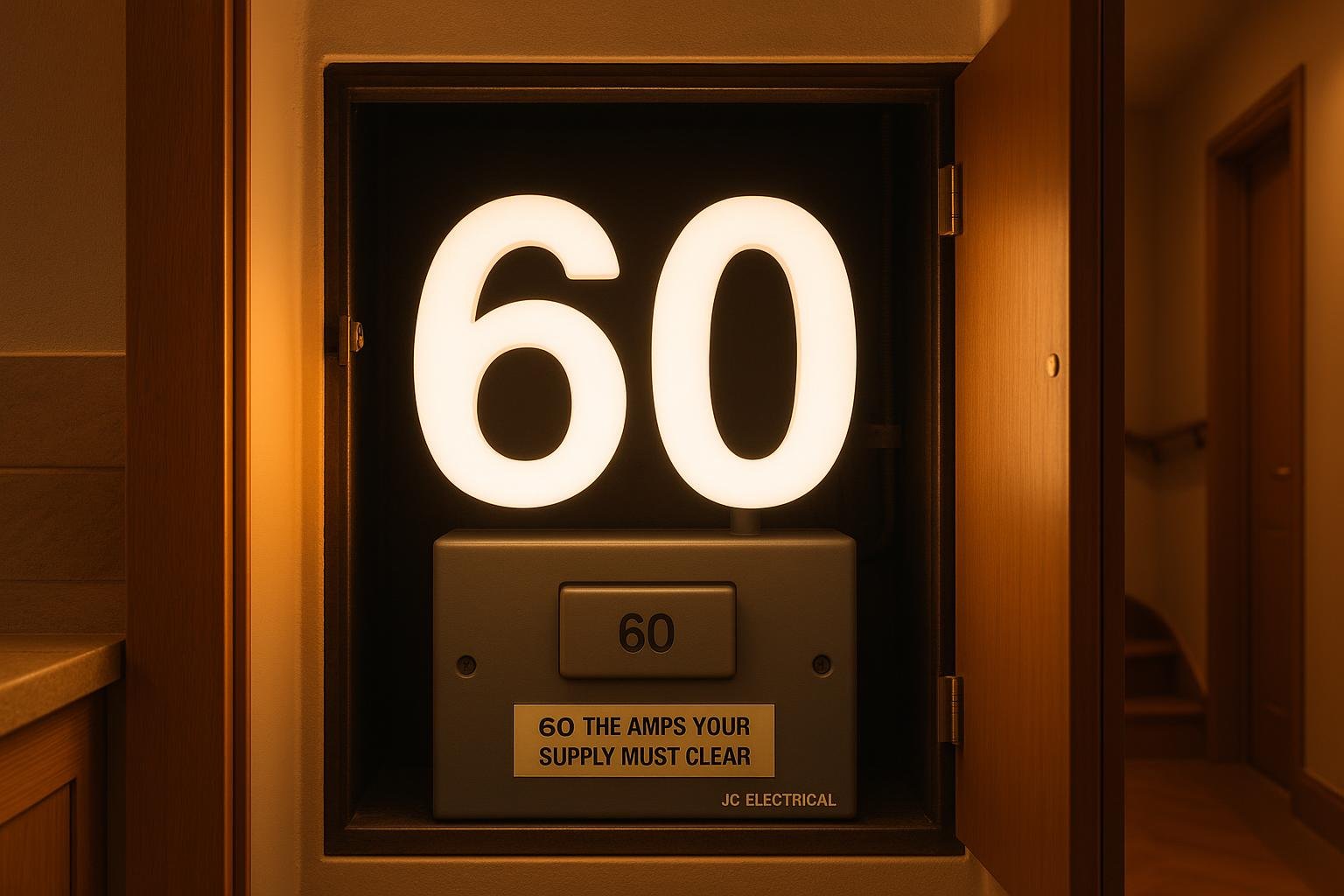
The cut-out fuse sets the maximum current your property can draw continuously. In houses built or last upgraded up to roughly the 1960s, this fuse is commonly rated at 60 amperes. In more recently upgraded properties it is usually 100 amperes. The difference matters a great deal when you are adding a 7 kW EV charger, which draws around 32 amperes on its own.
A house with electric heating, an electric shower, a modern cooker and then a 7 kW charger on top can genuinely exceed a 60A fuse under peak conditions. It does not trip like a circuit breaker does. It fails slowly and creates a fault that is difficult to fix quickly. So understanding your fuse rating before booking the charger installation is not bureaucratic caution, it is practical sense.
How do I read my own cut-out?
You do not need to open anything or touch any wiring. The cut-out is usually the first thing in the meter cupboard, before the meter itself. It is a sealed block, often grey or beige, with a ceramic or plastic body. The fuse rating is sometimes stamped on the body, sometimes printed on a label on the front, and sometimes marked on the fuse carrier visible through a small window.
Look for a number followed by A. 60A means the older, lower-capacity service. 100A means the modern standard. If the label is missing, faded, or you simply cannot read it safely, leave it and ask a registered electrician to identify it during a survey. Do not try to open the cut-out. It is sealed for good reason and breaking that seal is a network operator matter.
What is a looped supply and which houses have one?
A looped supply is where the network cable from the street runs into one property, then loops out again to serve the neighbouring property, rather than each house having its own dedicated cable. There is a cut-out in each house, but the underground cable is shared.
This arrangement was common during the interwar and postwar housing booms. Semi-detached pairs built in Beaconsfield, Amersham, and the surrounding villages between roughly 1930 and 1965 are the classic candidates. If your house is a semi from that era and you have never had significant electrical work done by the network operator, there is a reasonable chance you are still looped to your neighbour.
The practical consequence is that the capacity of that shared cable is split between two households. Adding a large continuous load on one side, like an EV charger running overnight, affects the headroom available to both properties. This is why the network operator needs to know about it.
What does SSEN do about it?
SSEN (Scottish and Southern Electricity Networks) is the distribution network operator for this part of South Buckinghamshire. They are responsible for the cables in the street and the cut-out in your meter cupboard. When you or your electrician notifies them of an EV charger installation, they assess the existing supply.
If your property is looped and the existing arrangement cannot safely support the additional load, SSEN will typically unloop the supply, giving each property its own dedicated cable. In most cases they do this at no direct charge to the homeowner, because it is a change to their own network infrastructure. What it does involve is time. Depending on workload, the wait can be anywhere from a couple of weeks to a couple of months. You cannot install a notifiable charger and then wait for SSEN to catch up afterwards. The notification and any network work need to happen first.
If your cut-out is 60A and needs upgrading to 100A as part of the process, SSEN handles that too, again usually without a charge to you. Your electrician coordinates this as part of the project. For more on what a board upgrade involves on your side of the cut-out, the guide to consumer unit and board upgrades in Beaconsfield covers that in full.
Does every EV charger need DNO notification?
Any charger rated above 3.5 kW requires the registered electrician to notify the distribution network operator before installation. A standard home 7 kW charger falls into this category. The notification is not optional and is not something you arrange yourself as the homeowner. Your electrician submits it as part of the job.
The reason for the requirement is straightforward. A large number of homes all running 7 kW chargers at the same time places a significant demand on local network infrastructure. The DNO needs visibility of what is being connected so they can plan capacity. In practice, most notifications are accepted without issue, but the process needs to complete before installation begins.
Does the same logic apply to hot tubs?
Yes, and it is worth thinking about if you are planning both. A hot tub is a large continuous load in a similar way to an EV charger. Running its heater element, which can be anywhere from 2 kW to over 6 kW, at the same time as a 7 kW charger, a shower, and an evening meal being cooked, is a realistic test of a 60A supply.
This does not mean you cannot have both. It means you need a load calculation done before committing to either. A realistic total of all the circuits that could run simultaneously, measured against the fuse rating, tells you whether there is headroom or whether the supply needs upgrading first. Doing that calculation at the planning stage is far less disruptive than discovering the problem after one or both installations are in.
What should I check before booking?
Before calling an electrician, it is worth spending five minutes in the meter cupboard with a torch. Note the fuse rating on the cut-out if you can read it. Check whether the house is a semi-detached and roughly when it was built. Look at the existing consumer unit and note how many circuits it has and whether there is any spare capacity visible.
None of this replaces a proper survey, but it gives the conversation a useful starting point. An electrician can then confirm the cut-out rating, identify whether a looped supply is present, calculate the load, notify SSEN where required, and either upgrade the consumer unit at the same time or confirm the existing board is adequate.
For houses in Beaconsfield, Amersham, Gerrards Cross, and the surrounding areas that were built in the postwar decades, the looped supply question comes up regularly. It is not a reason to delay the charger installation. It is simply a step in the process that needs to be managed correctly from the start.
What happens at the installation itself?
Once the supply side is confirmed and any SSEN work is done, the installation is usually a half-day job. A dedicated circuit runs from the consumer unit to the charger position, typically on an outside wall of the garage or at a suitable point on the driveway side of the house. The circuit is protected by its own breaker. The charger unit is fixed, wired, and tested. Building regulations notification is handled by your electrician as part of the same package.
If the consumer unit needs upgrading at the same time, that adds to the duration but still usually completes within a day for a standard domestic board. The range at the top of this page reflects the typical cost for that board work, and your specific quote will depend on what the survey finds.
If you have the details of your property ready, including the age of the house, whether it is a semi, and anything you can read off the cut-out, send them through using the form or number on this page and Jess will come back to you with a straightforward assessment of what your installation is likely to involve.