
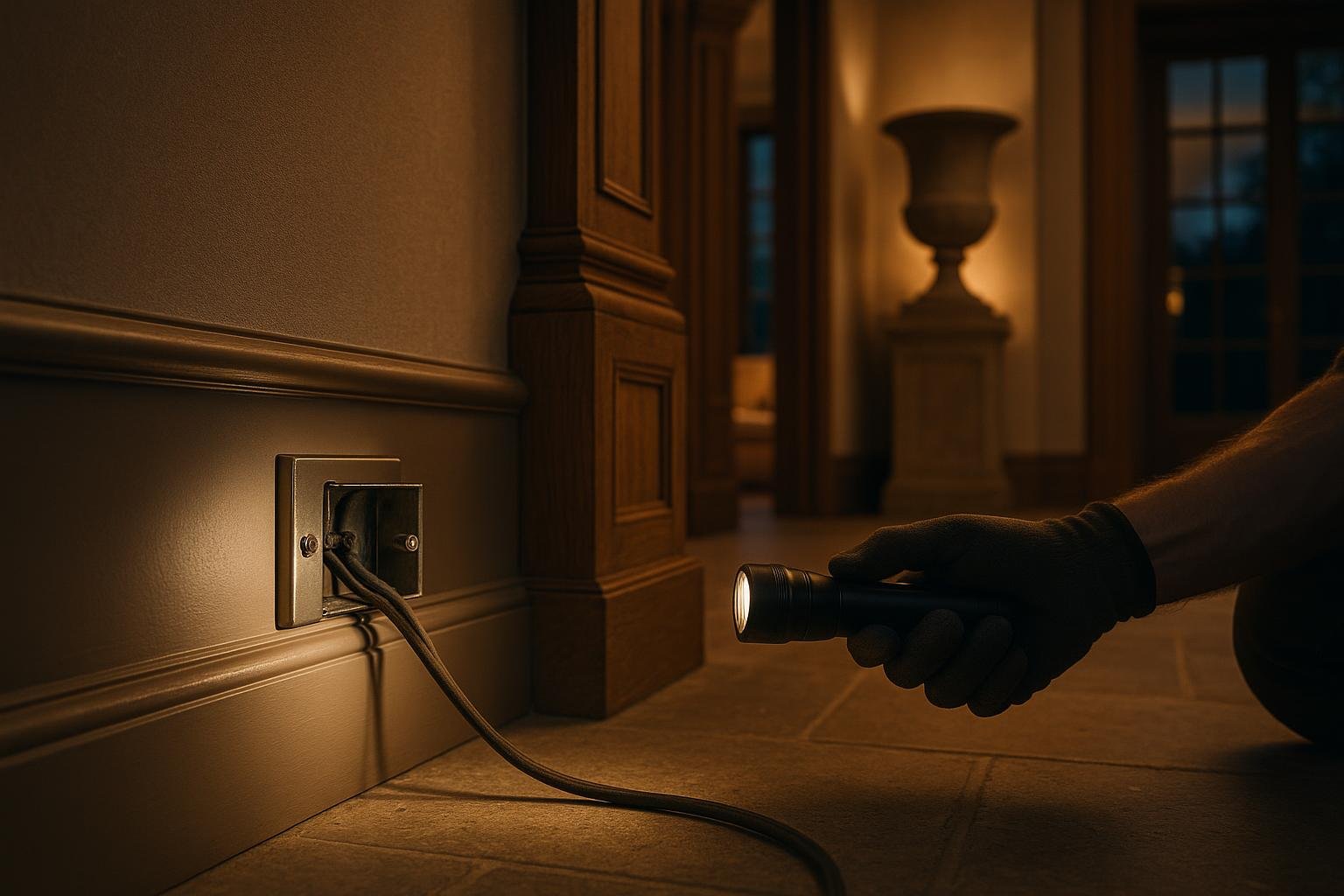
If you pull the cover from a socket in a house built before 1970 and shine a torch inside, what you see tells you a great deal about how urgent your next conversation with an electrician should be. The colours, the texture and the sheathing material are a rough timeline of British wiring practice, and each era brought its own failure modes. This guide explains what each type looks like, why it fails, and what to do if you find it in a house in Beaconsfield, Amersham, Gerrards Cross or anywhere else in South Buckinghamshire.
How do the main types of old wiring differ from each other?
Three types turn up most often in pre-1970 properties.
The first is vulcanised india rubber insulation, usually called VIR. It was used from the late Victorian period through to the 1950s. The rubber was wrapped around each conductor and then sheathed in a braided cotton or jute outer covering, sometimes coated in black tar. The insulation itself starts life flexible and resilient, but rubber degrades over time, especially where it is exposed to heat, such as in ceiling roses, near hot pipes or in airing cupboards. As it ages it becomes hard, then brittle, then it cracks. When it cracks, live conductors become exposed.
The second type is lead-sheathed cable. This was common from roughly the 1920s through to the late 1940s. Instead of a fabric braid, the outer covering is a soft, dull grey metal tube. You will sometimes see it running exposed along skirting boards or in cellars in older Beaconsfield properties. Lead itself does not present an electrical hazard, but the sheath corrodes, and where it has been cut, pinched or disturbed during building work over the decades, the rubber insulation inside is exposed.
The third type is tough rubber sheathing, often called TRS, which replaced VIR from the 1940s onwards and ran alongside early PVC cable into the 1960s. It is more robust than VIR but still ages, and by now any TRS installation is at least sixty years old.
What does each type look like when you open a socket?
With the circuit dead at the fuse board, unscrew the faceplate of one socket. Hold the faceplate away from the wall and look at the cables entering the back box.
VIR cables are usually black or dark brown on the outside. The fabric braid may have frayed. If you pinch the outer covering gently between two fingers and it feels hard rather than flexible, that is a sign the rubber has dried out. If it flakes or cracks, the cable needs replacing.
Lead-sheathed cable is unmistakable. The outer layer is a soft metallic grey tube, heavier than a modern PVC cable of the same cross-section. You may see whitish oxidation on the surface. The end where the sheath has been cut and stripped back often shows dark rubber insulation underneath.
TRS looks more like an early version of modern cable, black or grey outer sheath, but it has a denser, harder feel than PVC. The individual conductors inside are colour-coded in the old British scheme: red for live, black for neutral, green for earth. If you see red and black conductors in what looks like a reasonably modern socket, the circuit was wired before 2004.
For a broader picture of how to handle the electrics in older properties, the guide on period and listed home electrical work in Beaconsfield covers the wider planning and practical considerations.
What does the fuse board tell you about the age of the wiring?
The consumer unit, or fuse board, is often the clearest indicator. An old cast iron or brown Bakelite box with rewirable fuses, the kind where you thread a length of fuse wire between two terminals, almost certainly dates from the same era as VIR or lead-sheathed wiring. The fuse wire itself carries no earth protection. There is no RCD. A fault that a modern unit would disconnect in a fraction of a second will simply draw current until the fuse wire melts, which can take long enough for heat or arcing to cause a fire.
A later box, grey metal with ceramic cartridge fuses, suggests wiring from the 1960s or early 1970s. Better, but still without the protection a modern unit provides.
If the fuse board is modern but the cables running out of it still have red and black conductors, someone has upgraded the consumer unit without replacing the wiring. That is common. It improves protection at the board but does not fix the deteriorating insulation on the cables themselves.
What fails first and why?
Rubber insulation degrades fastest where it is hottest. Ceiling roses are a known problem point because a lamp fitting concentrates heat. Airing cupboards, where hot water pipes run close to cables, are another. The rubber directly around the conductors becomes powder-dry and falls away when the cable is disturbed during any building work, however minor.
Lead sheathing fails where it has been cut or knocked. Old buildings have often had several generations of plumbing and joinery work done, and each time someone drilled through a wall or lifted a floorboard, there was a chance of damaging the sheath. A small nick in the lead that was never noticed in 1962 may now expose a stretch of bare conductor inside a wall.
The earth conductor is another weak point in very old installations. Many pre-war circuits have no earth at all. Others use the lead sheath itself as the earth path, which only works while the sheath is continuous and making proper contact. The moment the sheath corrodes through or is cut, earth continuity is lost.
Rewirable fuses compound every one of these risks. If someone has fitted too heavy a fuse wire at some point, and it happens more often than you would expect, the overcurrent protection for that circuit is effectively removed. A fault that should blow the fuse will instead heat the cable until something else gives way.
What does an EICR actually check in a house like this?
An Electrical Installation Condition Report is a systematic inspection and test of every circuit in the property. For a pre-1970 house in Beaconsfield or Amersham, the report will test insulation resistance on each circuit, check earth continuity, verify that the protective devices will disconnect within the time limits set by current regulations, and look for visible damage to cables and accessories.
Each fault found is given a condition code. A C1 means danger present, requiring immediate action. A C2 means potentially dangerous. A C3 is a recommendation for improvement. An unsatisfactory result with C1 or C2 codes does not mean the house is about to catch fire tonight, but it does mean you should not leave it unattended for months.
For a house that has never had an EICR, or where the last one is more than ten years old, the inspection is the only way to know what you actually have. A visual look around is not enough. Insulation resistance can be very low without any visible sign of damage at the sockets and switches.
Can I just rewire one circuit and leave the rest?
Sometimes that is the right answer, and sometimes it is not. If the EICR finds a single circuit with poor insulation resistance and everything else tests satisfactorily, replacing that circuit is reasonable. But in practice, if the house is pre-1960 and the wiring has never been touched, all the circuits tend to be in a similar state because they were all installed at the same time using the same materials. Rewiring the kitchen circuit this year, the upstairs ring next year and the lighting the year after costs more in total than doing the work together, and it means living with disruption in three separate phases.
A partial rewire makes sense when part of the house has already been done, or when a clear extension or alteration means a new circuit is needed regardless.
How disruptive is the work in an older property?
In a house with solid brick or stone walls, running new cable means more surface work than in a timber-framed or cavity-wall property. Cables may need to run in conduit along walls rather than chased in. That is not unusual in Beaconsfield’s older stock, and a competent electrician will explain the options before any work begins. The choice between concealed and surface-run cable affects how the finished rooms look and how long the work takes, but both are done every day in period properties across the area.
In most houses the work takes a few days for a straightforward rewire, longer if access is difficult or the property is large. You may need to arrange for floors to be lifted in sections if the circuits run under suspended timber floors.
What should I do next?
If you live in, or are buying, a house in the Beaconsfield area that was built before 1970 and you are not certain when the wiring was last tested, the practical next step is an EICR. If the inspection finds that the wiring needs replacing, you will have a clear written record of why, what needs doing and how urgently. Use the contact details on this page to send the details of your property and Jess will talk you through what to expect before anyone starts work.