
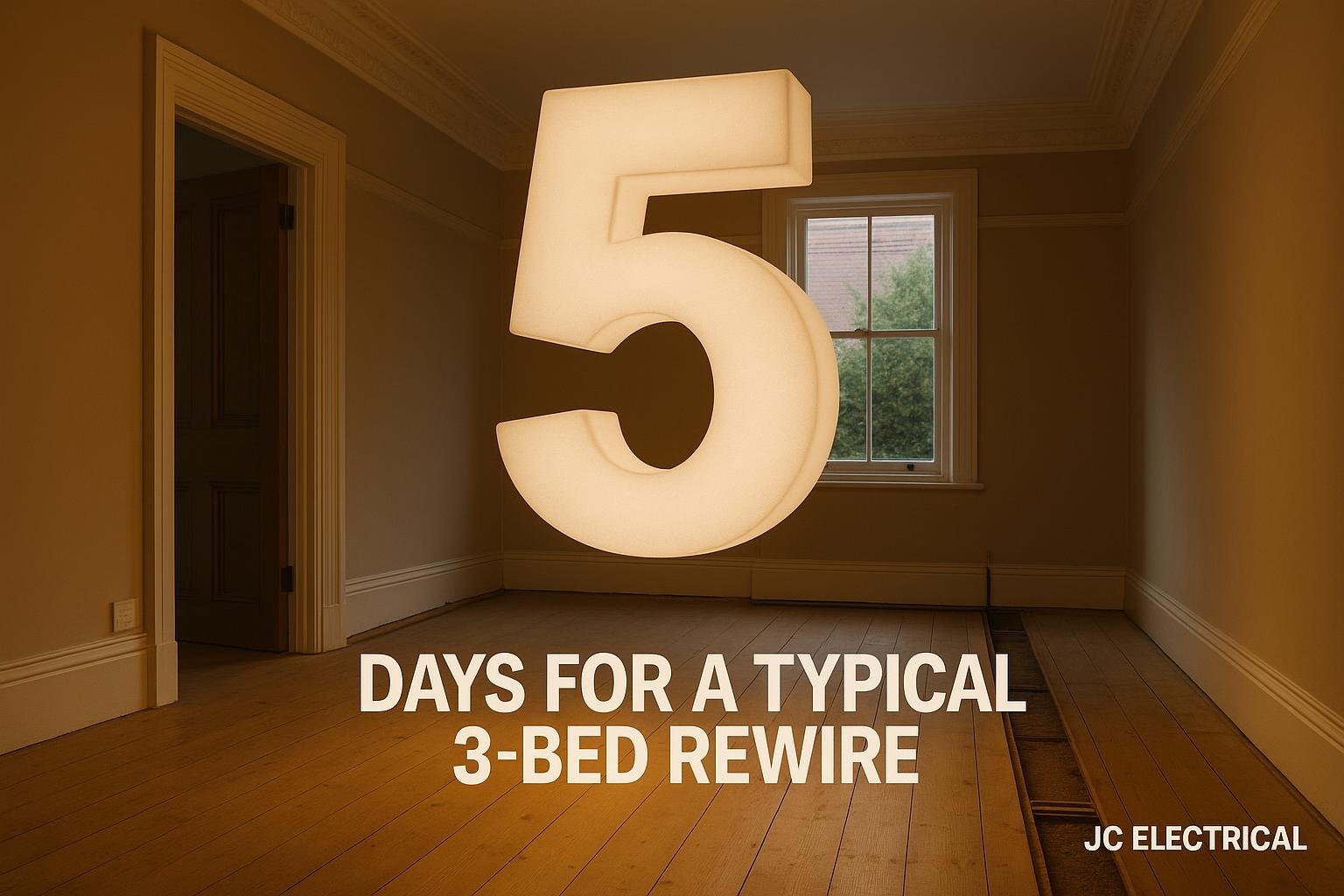
Homeowners searching for rewire timelines usually have a concrete reason: they are booking a plasterer, arranging somewhere else to sleep, or trying to fit a rewire around a kitchen installation. The honest answer is that the electrical work on a standard 3-bed semi in Beaconsfield takes five to eight working days, but several things can push that figure in either direction. This guide walks through the job day by day, flags the variables that stretch it, and explains what you as the homeowner can do to keep things moving.
What actually happens on each day of a rewire?
Day one is largely preparation and first fix. The electrician isolates the existing supply, removes the old consumer unit, and begins running new cable from the board position out to each circuit. In a 3-bed house there will typically be circuits for upstairs lighting, downstairs lighting, upstairs ring, downstairs ring, cooker, shower, and a few dedicated spurs. Each circuit needs cable chased into walls or run through the roof void, so the first day is the noisiest and dustiest.
Days two and three continue first fix, working room by room. The electrician drops cables to every socket and switch position, installs back-boxes, and leaves the ends coiled and ready. By the end of day three in a typical semi, first fix should be complete or close to it.
Day four is usually consumer unit installation and the start of second fix. The new board goes in, circuits are connected, and the electrician begins fitting faceplates, light fittings, and socket fronts in the rooms that are ready.
Days five and six complete second fix, carry out circuit testing, and prepare the paperwork for building control notification. A final inspection sign-off and the electrician’s certificate follow once everything tests correctly.
That is the clean version. Real houses add complications, which is what the rest of this guide is about.
How does a period property change the timeline?
Older houses in the Penn, Knotty Green and wider Beaconsfield area often have lath-and-plaster ceilings and solid brick or stone walls rather than the cavity walls and plasterboard you find in a postwar semi. Both of those features slow cable routing significantly.
Running cable through a lath-and-plaster ceiling without destroying it is careful, slow work. The electrician has to lift floorboards above where possible, feed cable on a draw wire, and avoid breaking the lath. Where the ceiling is below a concrete floor or there is no loft access, surface trunking or mini-trunking becomes the practical option. Either way, the job takes longer than in a modern house.
Solid walls cannot be chased with the same speed as a stud or cavity wall. A chasing tool helps, but the depth of plaster on an older wall varies, and some sections are reinforced with metal or studding that the tool cannot cut through cleanly. Expect to add one to two days on a period 3-bed compared with a 1970s equivalent.
For full detail on how Jess approaches older properties, see the guide on full house rewires in Beaconsfield.
What adds time in an occupied house?
Living in the house during a rewire is possible, but it does extend the job. There are a few reasons for this.
First, furniture has to move before cables can be chased. If a room is being used every evening, the electrician cannot leave it in a mid-chase state overnight. That means partially completing the work in a room, making it safe and usable again, then returning the next day to finish, rather than leaving everything open until the circuit is done.
Second, power has to be restored each evening. In an empty house the electrician can leave circuits incomplete overnight and pick up in the morning. In an occupied house a temporary supply arrangement is usually needed, which takes time to set up and restore each day.
Third, rooms with children, pets or a home office may only be available for part of the day, which compresses the working window.
A rough guide: an occupied 3-bed adds one to two days compared with the same house emptied and cleared. Some homeowners find staying with family for the first fix period, then returning for second fix, gives the best of both approaches.
How does making good affect the overall programme?
Electrical first fix leaves marks. Chased walls need filling. If plasterboard has been cut for back-boxes, those sections need patching. Ceilings that have been accessed from below show the entry points. None of this is unusual, and a good electrician will keep the damage to a minimum, but you should expect to need a plasterer after the electrician finishes.
Plastering and patching typically adds two to four days to the programme, and then the plaster needs to dry before you can redecorate. In practice, the full sequence from start of electrical work to walls being ready for paint is closer to two to three weeks once you include drying time.
If you are coordinating a rewire with a kitchen installation or bathroom refit in Amersham or Gerrards Cross, this is the timeline to plan around. The electrician finishes, the plasterer patches, the plaster dries, and then the decorator or kitchen fitter can work against a clean wall surface.
What can you do to shorten the rewire itself?
There are a handful of practical things that make a real difference to how quickly the electrical work moves.
- Clear rooms before the electrician arrives. Moving furniture, taking pictures off walls, and lifting rugs takes time that the electrician cannot really do for you. An empty room is a fast room.
- Decide in advance where every socket and switch is going. Changes mid-job mean re-running cable or repositioning back-boxes, which adds hours.
- Give the electrician access to the loft from day one. If the loft hatch is buried under stored items, retrieving and refilling the space costs the first morning of the job.
- Book the plasterer before the electrician starts, not after. Plasterers in this area are busy, and a two-week gap between trades is common if you leave the booking late.
- If you can empty and vacate the house for at least the first fix stage, do so. The time saving alone is worth a few nights away.
What is the timeline for larger or smaller houses?
A 2-bed flat or terraced house in Burnham or Wooburn Green might complete in three to four days if the layout is straightforward and access is good. At the other end, a large 4 or 5-bed detached in Marlow or Amersham can run to ten or twelve days, particularly if there are multiple reception rooms, an outbuilding to connect, or an older fabric that slows the cable routes.
The range at the top of this page reflects the size bands honestly. The square meterage matters less than the number of circuits, the condition of the existing wiring, and how accessible the floor and ceiling voids are.
What about the inspection and certificate?
A full rewire must be notified to building control. Your electrician handles this, and it does not usually add days to the programme itself. The inspection can often be booked to coincide with the final day of testing. Once the installation passes, the electrician issues the completion certificate and building control closes the notification.
You should keep the certificate safely because it will be needed if you sell the property or if a future EICR identifies the rewire as having been carried out. A buyer’s solicitor will ask for it.
The key point for your programme planning is that the certificate comes at the end of the job, not weeks later. If your electrician cannot tell you roughly when the certificate will be issued, that is worth clarifying before work starts.
How to get an accurate timeline for your house
The variables described above mean that an online estimate of days is only a starting point. The real answer depends on your house’s age and construction, the number of circuits, whether you are staying in during the work, and what is above the ceilings and behind the walls.
The best way to get a firm timeline for your specific property is to have Jess walk through the house before any dates are agreed. That visit takes around half an hour and gives you a realistic day-count, a clear picture of what the making-good work will involve, and a schedule you can use to book the other trades around.
If you are in Beaconsfield, Gerrards Cross, Amersham or any of the surrounding towns, use the form or number on this page to send the details of your job and arrange a time to take a look.