
The worry about where the family will sleep is often the thing that puts a rewire off for years. It is a fair concern — a rewire is not a small job — but for most households in Beaconsfield and the surrounding villages it does not mean booking a hotel or moving in with relatives. With some planning, life carries on at home while the work gets done.
How does the work actually happen day to day?
A rewire is done room by room, not all at once. The electrician works through the house in a logical order — usually starting at the top and working down — so that only one or two rooms are out of action on any given day. Floorboards come up, cables are run, boards go back down. By the time you are making dinner, the room that was being worked on is generally tidy enough to walk through, and the circuits you need for the evening are live.
The consumer unit (the fuse board) will be replaced at some point during the job, which means a short period — usually a few hours — where the whole house has no power. That is planned in advance so you can prepare. Everything else is managed in stages.
What will a normal evening look like during the rewire?
Most families find the evenings largely normal. The electrician leaves at the end of the day, the boards are down, and you have power to the rooms you need. You will want to keep one bathroom clear and usable throughout, and the kitchen should be live each night. It is worth having a conversation at the start of the job about which circuits matter most to you — a family with young children will have different priorities from a couple working from home.
Dust is the honest downside. Even with dust sheets and a tidy worker, replastering and chasing walls creates fine dust that travels. If anyone in the house has a respiratory condition, that is worth thinking about carefully.
When is moving out the smarter choice?
Staying home works well for a straightforward rewire in a modern or semi-modern house. It becomes harder when the rewire is combined with other work.
The most common situation where moving out genuinely makes sense is a full rewire in an older period property — the kind of large detached house you find in parts of Beaconsfield Old Town — where the original lath-and-plaster ceilings and solid walls mean more invasive work. If every ceiling needs to come down and every wall needs chasing out, the dust and disruption reaches a level where staying home is more miserable than it is worth, and the job actually takes longer because the electrician has to work around the family.
The same applies if the rewire is happening alongside a full replaster, a loft conversion or a significant renovation. When multiple trades are on site at once, the house stops functioning as a home for a week or two, and a short move-out is often the more practical decision.
For a standard three- or four-bedroom detached house in Beaconsfield, Gerrards Cross or Amersham with plasterboard walls and suspended timber floors, staying home is almost always manageable.
What should you do to prepare before the work starts?
A little preparation makes the whole week much easier.
- Clear each room before the electrician reaches it — you do not need to empty the house at once, just stay one room ahead.
- Identify which circuits matter most to you each evening (kitchen, one bathroom, the room where the children sleep) and tell the electrician at the start.
- Put away anything fragile or valuable from rooms that will be worked on.
- Have a plan for one or two evenings when the kitchen might be off for a few hours — a takeaway or a camping stove covers it.
- Accept that the house will be dustier than usual and do a proper clean at the end of the job rather than fighting it daily.
None of this is complicated. Most families who have been through a rewire say the anticipation was worse than the reality.
What happens with the consumer unit replacement?
The consumer unit is the one part of the job that briefly affects the whole house at once. It is usually replaced towards the end of the rewire, once all the new cables are in place. The power goes off for a few hours while the old board is disconnected and the new one is wired up and tested. Your electrician will give you notice so you can charge devices, plan around it, and know roughly when power will be back.
After the new board is fitted, each circuit is tested before it is switched back on. This is part of the certification process — a registered electrician will issue a certificate at the end of the job confirming the installation meets current standards. That certificate matters for your buildings insurance and for any future sale of the property.
For more detail on what a full rewire involves from start to finish, see the guide to full house rewires in Beaconsfield.
How long will you be living with the disruption?
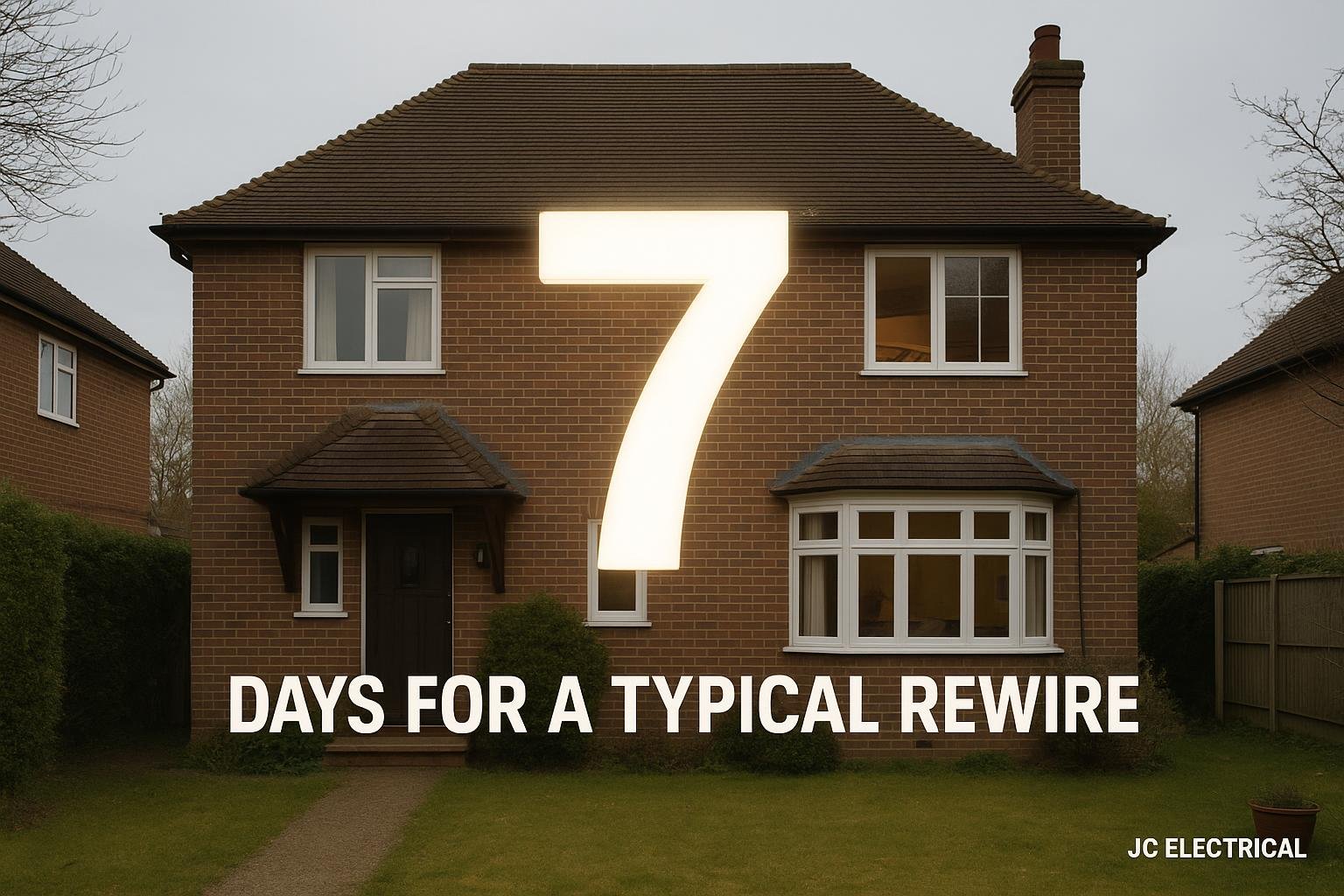
For a three-bedroom house, plan for five to seven working days. A larger four- or five-bedroom property — the kind of house common in Penn or Knotty Green — is more likely to take eight to twelve days, depending on the layout and how accessible the floor voids and roof space are. Solid walls, original floorboards fixed with cut nails, or a complicated layout all add time.
The range at the top of this page gives a realistic idea of cost for different house sizes. The duration and the cost are connected — a bigger, more complex house takes longer and costs more, but the day-to-day experience of living through it is broadly the same whatever the size.
What about the making-good afterwards?
Rewiring leaves some marks. Narrow channels are chased into walls for cables, floorboards are lifted and relaid, and socket and switch positions may change. A good electrician will fill and make good as part of the job, but making good is not the same as a fresh decoration. You will almost certainly want to redecorate the rooms after the rewire is done.
In most modern houses this is limited and manageable — a skim coat over the chased channels and a coat of paint. In older properties with original plasterwork it can be more significant. It is worth being clear at the quoting stage about what making-good is included, so there are no surprises at the end.
Ready to talk through your specific house?
Every house is different, and the honest answer to whether you can stay in yours during a rewire depends on the age of the property, the construction, and what else is happening at the same time. If you send the details — the size of the house, roughly when it was built, and whether you are combining the rewire with any other work — you will get a straight answer and a clear quote. Use the contact form or the phone number on this page to get in touch.